



Multicellular Dynamics
Self-organization of biological systems
Dr Luciano Marcon
Principal Investigator
Summary
How can identical embryonic stem cells form different tissues and organs? The traditional view of developmental biology is that the formation of different tissues is directed by external instructive signals. Increasing evidence however is showing that, when cultured as three-dimensional aggregates, embryonic stem cells can form tissues with complex architectures in the absence of instructive inputs. This remarkable self-organizing capacity has given birth to the field of organoid biology and promises to revolutionize tissue-engineering. The main goal of our laboratory is to identify the genetic and cellular mechanisms that underlie such self-organization. To do so we combine theory and experiments to study how embryonic stem cells spontaneously break their symmetry when cultured as spheroids known as embryoid bodies. Our research focuses on two main areas:
i) Investigate the patterning mechanism that drives symmetry breaking and embryonic axis formation in embryoid bodies and characterize its role during normal mouse development
ii) Study the cellular behaviours that drive axial elongation and gastrulation-like movements in embryoid bodies.
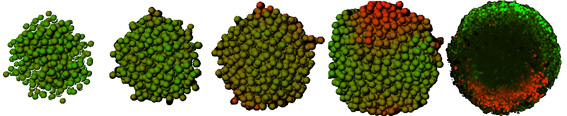
We address these questions by using a multidisciplinary systems biology approach, that combines experiments, three-dimensional light-sheet microscopy and computational modeling. Our long-term goal is to develop a comprehensive multicellular model of axis formation to study how gene regulatory networks, cellular behaviours and external signals are coupled by feedback to control patterning and morphogenesis. This integrative approach will allow us to understand the role of self-organization during embryonic development and to devise novel strategies for tissue-engineering.
Five relevant publications
Lab members & Collaborators
Lab members
Principal Investigator:
Dr. Luciano Marcon, +34 954348353
Postdoctoral Researchers:
Dr Jelena Raspopovic, +34 954349197
PhD students:
Jose Joaquín Serrano Morales
Julie Klepstad
Rosana Caceres Carrillo