



Scientific-Technical Facilities
Cytometry
1. Service definition
Flow cytometry is a powerful technique for the analysis of multiple parameters of individual cells within heterogeneous populations. The flow cytometers performs this analysis by passing thousands of cells per second through a laser beam and capturing the light that emerges from each cell as it passes through. The data gathered can be analyzed statistically by flow cytometry softwares to report cellular characteristics such as:
- Cell size (FSC)
- Cell complexity (SSC)
- Fluorescence
Flow cytometers have the ability to measure multiple celular parameters and markers of a large number of cells at a rapid rate. So the applications of flow cytometry are numerous, and this has led to the widespread use of these instruments in biological research.
The main applications that we have developed in the center are:
- Cell viability assays
- Membrane potencial
- Inmunophenotyping
- Cell cycle analysis
- Apoptosis and necrosis
- Cell sorting
- Stem cells (mouse)
- Cell lines
- Drosophila discs cells (eyes and wings)
- Hematopoietic cells (mouse blood, kidney, liver, bone marrow, spleen, thymus)
2. Offered services
- Assisting researchers in designing experiments
- Analytical cytometers’ user training
- Assisting researchers with analysis and data interpretation
- Sorting cell populations
3. Personnel and contact
- Mª José Sánchez Sanz- Scientific Coordinator
- Corín Díaz Ramos- Head Technician. CSIC. 954977432
- Macarena López Mayorga-Technician
4. Equipament
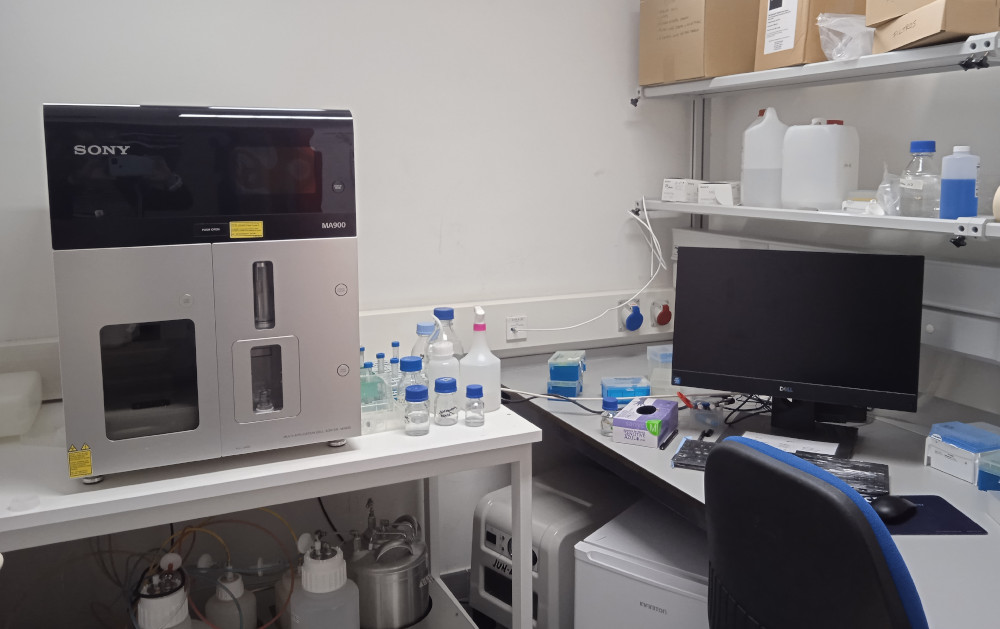
Sony MA900 Cell Sorter
- Four lasers on two axes: 488/561nm and 405/638 nm
- 14 parameters: FSC, BSC and 12 fluorescence colours
- Sample acquisition tube types: 0,5ml, 1.5ml, 5ml and 15ml
- Acquisition rates of up to 70 000 events per second
- Temperature control of sample and collection tubes: 5oC and 37oC
- Cell sorting in 2-way and 4-way tubes, epp or 6,12,24,48,96 & 384- well plates
- Index sorting software
- Nozzles: 70 and 100 micron
- Software: SONY-MA (online/offline)
The available optic configuration is detailed below:
| Láser | Filtros òpticos | LPF | Filtros BP | Fluorocromos |
| 405nm | FL6 | 450/50 | Dapi, Bviolet 421 | |
| FL7/LP10 | 487.5LP | 525/50 | BViolet510,Pacific Orange | |
| FL8/LP4 | 561LP | 585/30 | BViolet570 | |
| FL9/LP3 | 600LP | 617/30 | BViolet 605 | |
| FL10/LP7 | 639LP | 665/30 | BViolet 650 | |
| FL11/LP6 | 685LP | 720/60 | BViolet 711 | |
| FL12/LP5 | 752LP | 785/60 | BViolet 785 | |
| 488nm | FL1 | 525/50 | Fitc, AlexaFluor 488,EGFP,EYFP | |
| FL2/LP4 | 561LP | 585/30 | PE | |
| FL3/LP3 | 600LP | 617/30 | PE-Texas Red, PI, | |
| FL4/LP7 | 639LP | 695/50 | 7AAD, PE-cy5, PerCP | |
| FL5/LP1 | 752LP | 785/60 | PE-CY7 | |
| BSC | 488/17B | |||
| 561nm | FL2/LP4 | 561LP | 585/30 | mOrange, DsREd-Monomer, tdTomato |
| FL3/LP3 | 600LP | 617/30 | mCherry, Alexa Fluor 594 | |
| FL4/LP7 | 639LP | 695/50 | mPlum | |
| 638nm | FL10/LP7 | 639LP | 665/30 | APC, Cy5, Alexa Fluor 647 |
| FL11/LP6 | 685LP | 720/60 | APC-Cy5.5, Alexa Fluor 700 | |
| FL12/LP5 | 752LP | 785/60 | APC-Cy7, APC-Alexa Fluor 750 |
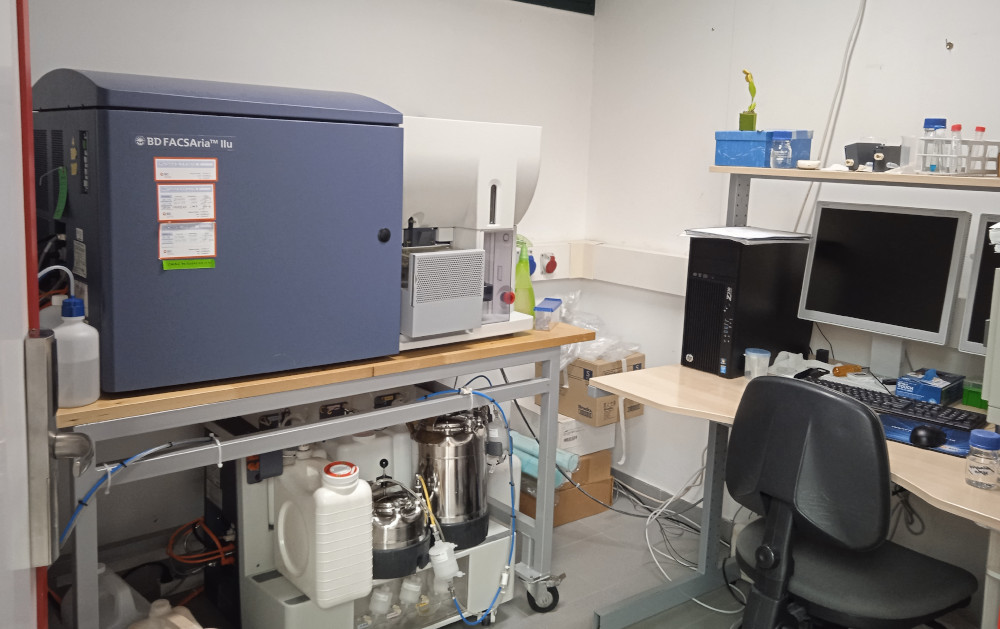
BD FACSAria Cell Sorter
- Two lasers: 488 nm y 633 nm
- 9 parameters: FSC, SSC and 7 fluorescence colors
- Sample acquisition with temperature control
- Acquisition rates of up to 70 000 events per seconds
- Sorts of up to four populations simultaneously
- Cell sorting in tube or culture plate
- Nozzles: 70 and 100 micron
- Software: FACSDiva
The available optic configuration is detailed below:
| Láser | PMT | LPF | Filtros BP | Fluorocromos |
| 488 nm | A | 735 | 780/60 | PE-Cy7 |
| B | 655 | 695/40 | PerCP-Cy5.5 ó PI | |
| 675/20 | PerCP ó PE-Cy5 | |||
| C | 595 | 610/20 | PE-Texas Red | |
| D | 556 | 576/26 | PE ó PI | |
| 585/42 | PE/PI | |||
| E | 502 | 530/30 | FITC | |
| F | 488/10 | SSC | ||
| 633 nm | A | 735 | 780/60 | APC-Cy7 |
| B | 685 | 712/21 | APC-Cy5.5 | |
| C | 660/20 | 660/20 | APC |
5. Rates
|
Offered services
|
RATES | ||
| UPO | University and OPIs | Enterprises/Others | |
| FacsAria Analysis | 7,60 €/h. | 23,00 €/h. | 30,50 €/h. |
| FacsAria Cell sorter | 10,15 €/h. | 30,50 €/h. | 40,60 €/h. |
| Sony MA900 Analysis | 7,60 €/h. | 23,00 €/h. | 30,50 €/h. |
| Sony MA900 Cell sorter | 10,15 €/h. | 30,50 €/h. | 40,60 €/h. |
6. Publications and web resources
Web resources
1. Invitrogen: Fluorescence Tutorials
www.invitrogen.com/site/us/en/home/support/Tutorials.html
2. BD Biosciences: Spectrum Viewer
https://www.bdbiosciences.com/en-us/resources/bd-spectrum-viewer
3. Purdue University Cytometry Laboratories
www.cyto.purdue.edu/
4. Iberian Cytometry Society
www.citometria.org/
5. Compensation tutorial
http://drmr.com/
6. Web tool for flow cytometry data analysis. (For questions, you may consult: https://umgcccfcsr.github.io/CytometryInR/course/00_Floreada/ or ask Macarena López.)
Flow basics 2.1: https://www.youtube.com/watch?v=gC4brjHbLkk Conceptos básicos sobre preparación de la muestra
Flow basics 2.2:https://www.youtube.com/watch?v=SXyeDKZecZA. Preparación de la muestra en más profundidad: digestión de la muestra: método de digestión, elección de enzima de digestión, titulación de anticuerpos, cantidad de células y cálculo del índice de tinción.
El resto de vídeos están más relacionados con la realización de la citometría:
Flow basics 2.3: https://www.youtube.com/watch?v=WHtqy3X_ch8
Flow basics 2.4: https://www.youtube.com/watch?v=b0MVzjeTzbk
Flow basics 2.5: https://www.youtube.com/watch?v=wTUviuik6rw
Publications
- Flow cytometry and cell sorting (1992) A. Radbruch
Springer-Verlag, Berlin.
(579 FLO) - In living color: protocols in flow cytometry Rochelle A. Diamond, Susan DeMaggio
(579 IN) - Flow Cytometry. A Practical Approach (2000) Ormerod, MG.
3rd edition. Oxford University Press, Oxford. Robinson, J.P.,
(576 FLO) - Practical Flow Cytometry (2003) Howard Shapiro.
Fourth Edition Wiley-Liss, New York
(576 SHA) - Cytometry: new developments (2004)San Diego: Elsevier
(576 CYT) - Flow cytometry protocols (2004)
Totowa, New Jersey, Humana Press, cop.
(576 HAW flo) - Flow cytometry: principles and applications (2007)
Totowa, New Jersey, Humana Press, cop.
(576 FLO)