


Genome Dynamics

Vertebrate development and evolution

Dr Javier Lopez-Rios 

Principal Investigator

Summary 


In our lab, we use the developing mouse limb as a model to gain fundamental knowledge into the cellular and molecular mechanisms that control organogenesis. To do so, we combine the strengths of genetic analysis in the mouse with the use of functional genomics to get mechanistic insight into these developmental processes.
Currently, our main areas of interest are:

1) Transcriptional integration of SHH signaling. The SHH ligand is essential for the formation of the distal limb. We are trying to understand how limb mesenchymal cells integrate the concentration and timing of SHH exposure and elaborate accordingly a transcriptional response. To do so, we are functionally dissecting the regulatory landscapes of SHH-responding genes in the mouse limb using CRISPR-Cas9 technologies and transgenic reporter assays.

2) Evolutionary diversification of the limb. Tetrapods have conquered all habitats on Earth thanks to the specialization of their limb anatomy for running, flying, burrowing, swimming, etc. These adaptations involve all sorts of anatomical alterations of the limb, including the gain/loss of digits, changes in the size and shape of bones, etc.


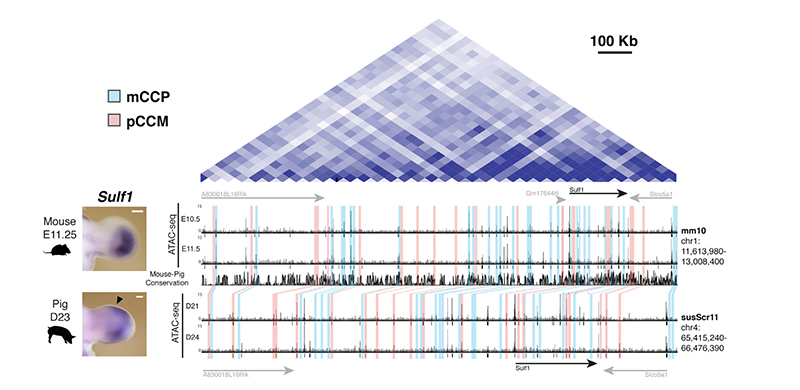
In the lab we combine quantitative gene expression analysis and functional epigenomics (ATAC-seq, ChIP-seq, 4C-seq) in mouse, chicken and pig embryos to identify divergent regulatory strategies in the genomic landscapes of genes with essential functions in limb development. The functional relevance of the candidate alterations is later addressed by modification (deletion, replacement, etc.) of the selected regulatory region in the mouse genome using CRISPR/Cas9 methods.

3) In addition, we are interested in deciphering the mechanisms that specify the different populations of skeletal stromal cells. To do so, we take advantage of genetic lineage tracing and single cell functional genomics. In particular, we are interested in the therapeutical use of these cells, given their strong immunoregulatory properties.

These are exciting times to study how form is encoded in the genome and which are the mechanisms behind morphological evolution! If you are interested in joining the lab for your PhD/Master thesis or as a postdoctoral fellow, please send your CV and motivation letter to jloprio@upo.es.

Relevant publications 


  • Letelier J#, Naranjo S#, Sospedra-Arrufat I, Martínez-Morales JR,  Lopez-Rios J*, Shubin N*, Gómez-Skarmeta JL* (2021). The Shh/Gli3 gene regulatory network precedes the origin of paired fins and reveals the deep homology between distal fins and digits. Proc Natl Acad Sci USA 118(46): e2100575118.   Featured in El País (Nov 8, 2021)  > ver articulo 
  • Tissières V, Geier F, Kessler B, Wolf E, Zeller R, Lopez-Rios J. (2020). Gene regulatory and expression differences between mouse and pig limb buds provide insights into the evolutionary emergence of artiodactyl traits. Cell Rep 31 (1): 107490. 
  • Osterwalder M, Barozzi I, Tissières V, Fukuda-Yuzawa Y, Mannion BJ, Afzal SY, Lee EA, Zhu Y, Plajzer-Frick I, Pickle CS, Kato M, Garvin TH, Pham QT, Harrington AN, Akiyama JA, Afzal V, Lopez-Rios J, Dickel DE, Visel A, Pennacchio LA. (2018). Enhancer redundancy provides phenotypic robustness in mammalian development. Nature, 554(7691):239-243. 
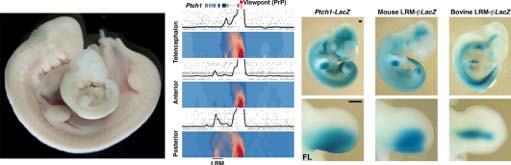
  • Lopez-Rios J#, Duchesne A#, Speziale D, Andrey G, Peterson KA, German P, Ünal E, Liu J, Floriot S, Barbey S, Gallard Y, Müller-Gerbl M, Courtney AD, Klopp C, Rodriguez S, Ivanek R, Beisel C, Wicking C, Iber D, Robert B, McMahon AP, Duboule D and Zeller R. (2014) Attenuated sensing of SHH by Ptch1 underlies evolution of bovine limbs. Nature, 511(7507):46-51. 
  • Osterwalder M, Speziale S, Shoukry M, Mohan R, Ivanek R, Kohler M, Beisel C, Wen X, Scales SJ, Christoffels VM, Visel A, Lopez-Rios J* and Zeller R*. (2014). HAND2 targets define a network of transcriptional regulators that compartmentalize the early limb bud mesenchyme. Dev Cell, 31:345 – 357. 
  • Lopez-Rios J, Speziale D, Robay D, Scotti M, Osterwalder M, Nusspaumer G, Galli A, Holländer GA, Kmita M, Zeller R. (2012). GLI3 Constrains Digit Number by Controlling Both Progenitor Proliferation and BMP-Dependent Exit to Chondrogenesis. Dev Cell, 22:837–848. 
  • Osterwalder M, Galli A, Rosen B, Skarnes WC, Zeller R*, Lopez-Rios J*. (2010). Dual RMCE for efficient re-engineering of mouse mutant alleles. Nat Methods, 7: 893-895.

Lab members & Collaborators


Lab members


Principal Investigator:

Dr. Javier Lopez-Rios, +34 954 978 087, jloprio@upo.es

Associated Senior Researcher:

Dr. Gretel Nusspaumer, +34 954 978 088, gnusda@upo.es

Bioinformatician

Lucía Almorox, +34 954 978 088

PhD Students:

Ismael Sospedra, +34 954 978 088, isosarr@upo.es
Ana Alcaina, +34 954 978 088, aalccar@upo.es
Alejandro Díaz, +34 954 978 088, adiarue@upo.es
Julia Pawluk, +34 954 978 088, jpaw@upo.es (co-supervised with Dr. Bárbara Pernaute)

Collaborators 

Dr. Juan Tena. Centro Andaluz de Biología del Desarrollo-CSIC, Seville, Spain.
Dr. Holger Heyn. Centro Nacional de Análisis Genómico, Barcelona. Spain.
Dr. Darío Lupiañez. Max Delbrück Center for Molecular Medicine. Berlin, Germany.
Dr. Marco Osterwalder. University of Bern, Switzerland.
Dr. Axel Visel. Lawrence Berkeley National Laboratory, USA.
Dr. Rolf Zeller. University of Basel, Switzerland.
Dr. Eckhard Wolf. Gene Center LMU. Munich, Germany.
Dr. Santiago Rodríguez de Córdoba. Centro de Investigaciones Biológicas-CSIC, Madrid, Spain.