



Evolutionary Dynamics
Evolution of organogenetic gene networks

Dr James C.-G. Hombría
Principal Investigator
Summary
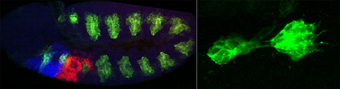
1- Gene network divergence during the evolution of homologous organs:
Despite their different shape and function, we have developmental and genetic evidence indicating that endocrine glands and trachea evolved by the divergence of an ancient metamerically repeated organ. We have found that the trachea, the corpora allata and the prothoracic glands form at segmentally homologous positions, they can be homeotically transformed into each other, and they are specified using very similar gene networks involving JAK/STAT signalling and Hox input. However, despite their homology, the glands and the trachea primordia have different developmental behaviours that are mediated by the differential activation in the glands of the Sna epithelial to mesenchymal transition (EMT) regulator and by the activation in the trachea of the Trh transcription factor. We have also found that a conserved insect endoskeletal element, the tentorium, originates in the head from this same homology group of cells. We are currently analysing the genes shared by these three organogenetic networks, as well as the organ specific genes whose activation leads to their developmental diversification.
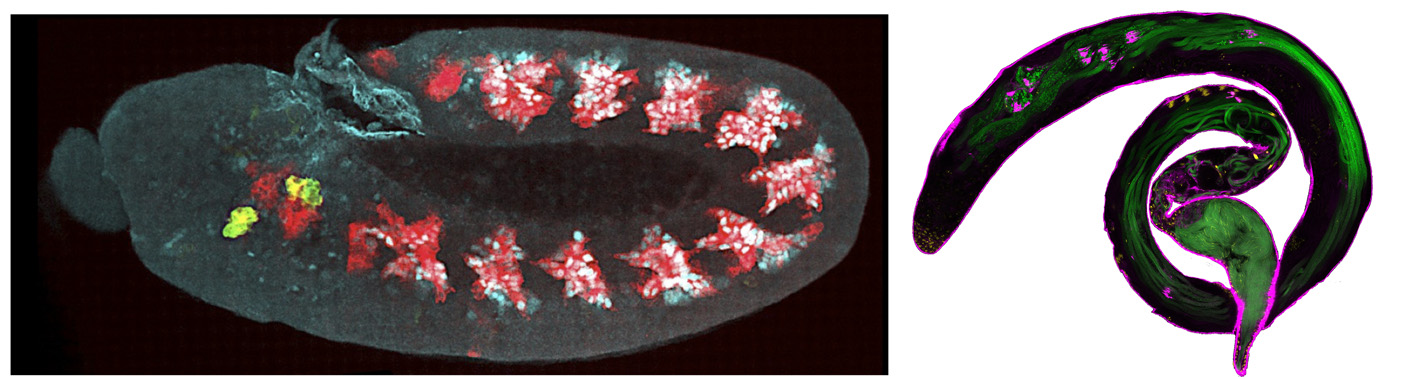
2- Co-option of the posterior spiracle gene network:
We found that Abd-B modulates in the eighth abdominal segment (A8) a gene network that includes several signalling pathways and other transcription factors, which activate cell adhesion proteins, cell polarity regulators and cytoskeletal regulators.
Our analysis of this posterior spiracle gene network uncovered an evolutionary novelty, the activation of the posterior-specific engrailed gene in the anterior part of the A8 segment. Engrailed expression has been restricted over 500 million years to the posterior part of each segment in all arthropods. Comparison of En expression in other Diptera shows that the anterior A8 compartment activation evolved in the Drosophilids. Using CRISPR/Cas9 we have deleted the enhancer driving the anterior spiracle specific A8 en expression. Despite eliminating En expression from the A8 anterior compartment, the deletion does not result in abnormal spiracle organogenesis, but males are sterile. We have found that Engrailed and the en spiracle enhancer are expressed in the mesodermal cyst cells that encapsulate the sperms in the adult testis, where they are necessary for sperm liberation (spermiation). We discovered that a substantial part of the posterior spiracle gene network is activated in the testis cyst cells using the enhancers driving expression in the embryonic spiracles, suggesting that the posterior spiracle network has been recently co-opted to the testis. We are currently analysing what is the role of the posterior spiracle genes in the testis and how this co-option event has affected the posterior spiracle regulatory network.
Five relevant publications
Lab members & Collaborators
Lab members
Principal investigator:
Dr James C-G Hombría, +34 954348942
Associated investigator:
Dr. Sol Sotillos (Senior Research Scientist, CSIC), +34 954977914
Postdoctoral:
Dr. Laura Terrón González, +34 954348686
Dr. José (Pepe) Urbano Fernández, +34 954348686
PhD students:
Sara Molina Gil, +34 954348686
Daniel Barcenilla Merino, +34 954348686
Álvaro Marrufo Mena, +34 954348686
Emilio González Martín (Co-directed with Victor Álvarez Tallada)
Previous lab members:
Dr. Carlos Sánchez Higueras
Dr. Mar Silvia García Ferrés
Dr. Marisa Rivas Peña
Dr. Pedro Pinto
Dr. Francisco Velázquez Duarte
Dr Mario Aguilar Aragón
Filippo Foglia
Jose Manuel Espinosa Vázquez
(When located at the Depart. of Zoology. Univ. of Cambridge)
Dr Bridget Lovegrove
Dr Stephen Brown
Nan Hu
Collaborators
Dr. Hansong Ma (Univ. of Birmingham, UK)
Dr. Satoru Kobayashi (Univ. Tsukuba, Japan)
Dr. Miho Asaoka (Univ. Tsukuba, Japan)
Dr. Guillaume Junion (University of Clermont-Ferrand, France)
Dr. Richard Mann (Columbia University, USA)
Dr. Harmen Bussemaker (Columbia University, USA)
Dr. Victor Álvarez Tallada (CABD, U. Pablo de Olavide, Spain)
Prof. Anna Lauber-Biason (University of Fribourg, Switzerland)
Prof. Ludmila Livshits (Institute of Molecular Biology and Genetics, National Academy of Sciences, Ukraine)
Dr. Daniel Rodríguez Gutiérrez (University of Fribourg, Switzerland)
Dr. Nadia Monesi (University of Sao Paulo, Brasil)
Full publication list
Research papers
Barcenilla-Merino D., Sánchez-Higueras C. and C.-G. Hombría J. (2025). Divergent origin of the insect cephalic endoskeleton and the trachea from a homologous metameric structure. Current biology 35: 4165-4177.
Molina-Gil S., Sotillos S., Espinosa-Vázquez J.M., Almudí I. and C.-G. Hombría J. (2023). Interlocking of co-opted developmental gene networks in Drosophila and the evolution of pre-adaptive novelty. Nature Communications 14:5730.
Von der Decken I., Domenech Mercadé I., Srinivasan S., Sirokha D., Livshits L., Vanni S., Nef S., Biasson-Lauber A., Rodríguez Gutiérrez D. and Hombría C-G J. (2022). A conserved function of Human DLC3 and Drosophila Cv-c in testis development. eLife 11:e82343.
García-Ferrés M. and Sánchez-Higueras C., Espinosa Vázquez J.M. and Hombría C-G J. (2022). Specification of the endocrine primordia controlling insect moulting and metamorphosis by the JAK/STAT signalling pathway. PLoS genetics 18: e1010427.
Sánchez-Higueras C., Rastogi C., Voutev R., Bussemaker H.J., Mann R.S. and C.-G. Hombría J. (2019). In vivo Hox binding specificity revealed by systematic changes to a single cis regulatory module. Nature Communications 10:1-13.
Sotillos S., Aguilar M. and Castelli-Gair Hombría J. (2018). Functional analysis of the Drosophila RhoGAP Cv-c protein and its equivalence to the human DLC3 and DLC1 proteins. Scientific Reports 8:4601 (11pages).
Uliana J.V.C., Brancini G.T.P., Castelli-Gair Hombría J., Digiampietri L. A., Andrioli L.P. and Monesi N. (2018). Characterizing the embryonic development of B. hygida (Diptera: Sciaridae) following enzymatic treatment to permeabilize the serosal cuticle. Mechanisms of Development (2018) 154: 270-276.
Sánchez-Higueras, C. and Castelli-Gair Hombría J. (2016). Precise long-range migration results from short-range stepwise migration during ring gland organogenesis. Developmental Biology 414:45-57.
Pinto, P., Espinosa-Vazquez J.M., Rivas M.L. and Castelli-Gair Hombría J. (2015). JAK/STAT and Hox dynamic interactions in an organogenetic gene cascade. PLoSgenetics. 11:e1005412.
Sánchez-Higueras, C., Sotillos S. and Castelli-Gair Hombría J. (2014). Common origin of insect trachea and endocrine organs from a segmentally repeated precursor. Current Biology. 24 , 76-81.
Sotillos S., Aguilar M. and Castelli-Gair Hombría J. (2013). Forces shaping a Hox morphogenetic gene-network. Proc. Natl. Acad. Sci. USA. 110, 4303-4308.
Sotillos S., Krahn M., Espinosa-Vazquez J.M. and Castelli-Gair Hombría J. (2013). Src kinases mediate apical determinant Bazooka/PAR3 interaction with STAT92E and increasesignalling efficiency in Drosophila ectodermal cells. Development. 140, 1507-1516.
Rivas M.L., Espinosa-Vazquez J.M., Sambrani N., Greig S., Merabet S., Graba Y. and Castelli-Gair Hombría J. (2013). Antagonism versus cooperativity with TALE cofactors at the base of the functional diversification of Hox protein function. PLoS genetics. 9: e1003252.
Sotillos S., Espinosa-Vazquez J.M., Foglia F., Hu N. and Castelli-Gair Hombría J. (2010). An efficient approach to isolate STAT regulated enhancers uncovers STAT92E fundamental role in Drosophila tracheal development. Developmental Biology. 340, 571-592.
Rivas M.L., Cobreros L., Zeidler M. P. and Castelli-Gair Hombría J. (2008). Plasticity of Drosophila STAT DNA binding shows an evolutionary basis for STAT transcription factor preferences. EMBOreports 9, 1114-1120.
Sotillos S., Díaz-Meco, M.T., Moscat, J. and Castelli-Gair Hombría J. (2008). Polarized subcellular localization of JAK/STAT components is required for efficient signalling. Current Biology. 18, 624-629
Lovegrove B., Simões S., Rivas M.L., Sotillos S., Johnson K., Knust E., Jacinto A. and Castelli-Gair Hombría J. (2006) Co-ordinated control of cell adhesion, cell polarity and cytoskeleton underlies Hox induced organogenesis in Drosophila. Current Biology 16, 2206-2216.
Simões S., Denholm B., Azevedo D., Sotillos S., Martin P., Castelli-Gair Hombría J. and Jacinto A. (2006) Compartimentalisation of Rho regulators directs cell invagination during tissue morphogenesis. Development 133, 4257-4267.
Brown S., Zeidler M. P. and Castelli-Gair Hombría J. (2006). JAK/STAT signalling in Drosophila controls cell motility during germ cell migration. Developmental Dynamics. 235, 958-966.
Castelli-Gair Hombría J., Brown S., Häder S. and Zeidler M. P. (2005). Characterisation of Upd2, a Drosophila JAK/STAT pathway ligand. Developmental Biology. Developmental Biology 288, 420-433.
Merabet S. Castelli-Gair Hombría J., Hu N., Pradel J. and Graba Y. (2005) Hox-controlled reorganisation of intrasegmental patterning cues underlies Drosophila posterior spiracle organogenesis. Development 132, 3093-3102.
Denholm B., Brown S., Ray R.P., Ruiz-Gómez M., Skaer H. and Castelli-Gair Hombría J. (2005). crossveinless-c is a RhoGAP required for cytoskeletal reorganisation during Drosophila embryonic morphogenesis. Development. 132, 2389-2400.
Mukherjee T., Castelli-Gair Hombría J. and Zeidler M. P. (2005) Opposing roles for Drosophila JAK/STAT signalling during cellular proliferation. Oncogene. 24, 2503-2511.
Brown S., Hu, N and Castelli-Gair Hombría J. (2003). Novel level of signalling control revealed by in situ visualisation of protein-protein interaction during development. Development 130, 3077-3084.
Brown S., Hu, N and Castelli-Gair Hombría J. (2001). Identification of the first invertebrate Interleukin JAK/STAT receptor, the Drosophila gene domeless. Current Biology. 11, 1700-1705.
Brown S. and Castelli-Gair Hombría J. (2000). Drosophila grain encodes a GATA transcription factor required for cell rearrangement during morphogenesis. Development. 127, 4867-4876.
Hu N. and Castelli-Gair J.E. (1999). Study of the posterior spiracles of Drosophila as a model to understand the genetic and cellular mechanisms controlling morphogenesis. Developmental Biology. 214, 197-210.
Castelli-Gair J.E. (1998). Implications of the spatial and temporal regulation of Hox genes on development and evolution. Int. J. Dev. Biol. 42, 437-444.
Castelli-Gair J. (1998). The lines gene of Drosophila is required for specific functions of the Abdominal-B HOX protein. Development 125, 1269-1274.
Castelli-Gair J.E. and Akam M.E. (1995). How the Hox gene Ultrabithorax specifies two different segments: the significance of spatial and temporal regulation within metameres. Development 121, 2973-2982.
Castelli-Gair J.E., Greig S., Micklem G. and Akam M.E. (1994). Dissecting the temporal requirements for homeotic gene function. Development 120,1983-1995.
Camprodón F. J. and Castelli-Gair J.E. (1994). Ultrabithorax protein expression in breakpoint mutants: localization of single, co-operative and redundant cis regulatory elements. Wilhelm Roux’s Arch. Dev. Biol. 203, 411-421.
Castelli-Gair J.E., Capdevila M.P., Micol J.L. and García-Bellido, A. (1992). Positive and negative cis-regulatory elements in the bithoraxoid region of the Drosophila Ultrabithorax gene. Mol Gen Genet 234, 177-184.
Castelli-Gair J.E., Müller J. and Bienz M. (1992). Function of an Ultrabithorax minigene in imaginal cells. Development 114, 877-886.
Castelli-Gair J.E., Micol J.L. and García-Bellido, A. (1990). Transvection in the Drosophila Ultrabithorax gene: a Cbx1 mutant allele induces ectopic expression of a normal allele in trans. Genetics 126, 177-184.
Micol J.L., Castelli-Gair J.E. and García-Bellido, A. (1990). Genetic analysis of transvection effects involving cis-regulatory elements of the Drosophila Ultrabithorax gene. Genetics 126, 365-373.
Castelli-Gair J.E. and García-Bellido, A. (1990). Interactions of Polycomb and trithorax with cis regulatory regions of Ultrabithorax during the development of Drosophila melanogaster. EMBO J. 9, 4267-4275.
Reviews
Hombría C-G J., García-Ferrés M. and Sánchez-Higueras C. (2021). Anterior Hox genes and the process of cephalization. Frontiers in Cell and Developmental Biology 9, 718175.
Hombría C-G J. and Sotillos, S. (2020). Evo-Devo: When four became two plus two. Current Biology. 30; R655-R657.
Castelli-Gair Hombría J. and González-Reyes, A. (2016). Cell signalling: combining pathways for diversification and reproducibility. Current Biology. 26; R1153-R1155.
Castelli-Gair Hombría J. and Sotillos, S. (2013). JAK-STAT pathway in Drosophila morphogenesis. From organ selector to cell behavior regulator. JAK-STAT. 2; 3, e26089.
Castelli-Gair Hombría J. and Serras, F. (2013). Why should we care about fly tumors? The case of JAK-STAT and EGFR cooperation in oncogenesis. JAK-STAT. 2; 2, e23203.
Castelli-Gair Hombría J. (2011). Butterfly eyespot serial homology: enter the Hox genes. BMC Biol. 9,26.
Castelli-Gair Hombría J., Rivas M.L. and Sotillos, S. (2009). Genetic control of morphogenesis- Hox induced organogenesis of the posterior spiracles. Int. J. Dev. Biol. 53, 1349-1358.
Castelli-Gair Hombría J. and Sotillos, S. (2008). Disclosing JAK/STAT links to cell adhesion and cell polarity. Seminars in Cell and Developmental Biology 19, 370-378.
Castelli-Gair Hombría J. and Sotillos, S. (2006). JAK/STAT signalling: STAT cannot play with Ken and Barbie. Current Biology 16, R98-R100.
Castelli-Gair Hombría J. and Lovegrove, B. (2003). Beyond homeosis-HOX function in morphogenesis and organogenes. Differentiation 71, 461-468.
Castelli-Gair Hombría J. and Brown, S. (2002). The fertile field of Drosophila JAK/STAT signalling. Current Biology 12, R569-R575.
Akam M., Averof M., Castelli-Gair J., Dawes R., Falciani F. and Ferrier D. (1994). The evolving role of Hox genes in arthropods. Development 120 Supplement, 209-215.
Book chapters
Castelli-Gair Hombría J., Sánchez-Higueras C., Sánchez-Herrero E. (2016). Control of organogenesis by Hox genes. In : “Organogenetic gene networks” Castelli-Gair Hombría, J. and P. Bovolenta (eds.) (ISBN: 978-3-319-42765-2). Springer. Cham, Switzerland.
Castelli-Gair Hombría J., and P. Bovolenta (2016). Models for studying organogenetic gene networks in the 21st century. In : “Organogenetic gene networks” Castelli-Gair Hombría, J. and P. Bovolenta (eds.) (ISBN: 978-3-319-42765-2). Springer. Cham, Switzerland.
Castelli-Gair J.E. (1999). Homeotic genes. Vol. 2: 1161-1163. In: Encyclopedia of molecular biology. (T. E. Creighton, ed.), John Wyley and Sons, Inc. New York.
Castelli-Gair J.E. (1999). Homeotic genes. Vol. 2: 1161-1163. In: Encyclopedia of molecular biology. (T. E. Creighton, ed.), John Wyley and Sons, Inc. New York.
Castelli-Gair J.E. (1999). Ultrabithorax genes. Vol. 4: 2717-2719. In: Encyclopedia of molecular biology. (T. E. Creighton, ed.), John Wyley and Sons, Inc. New York.
Castelli-Gair J.E., Elvira R., Sánchez M.J. and Ramos, A. (1983). Zonas Verdes de Carabanchel. In: Carabanchel Puertas Abiertas. Ed. Junta Municipal de Carabanchel. Madrid, (Spain).
Edited books
Castelli-Gair Hombría J. and P. Bovolenta (eds.). Organogenetic gene networks. Genetic control of organ formation (ISBN: 978-3-319-42765-2). Springer. Cham, Switzerland.(2016).