



Organismal Dynamics

Neuron-glia mitochondrial stress communication in ageing and neurodegeneration
Dr. Jesus Fernandez Abascal
Researcher

Summary 
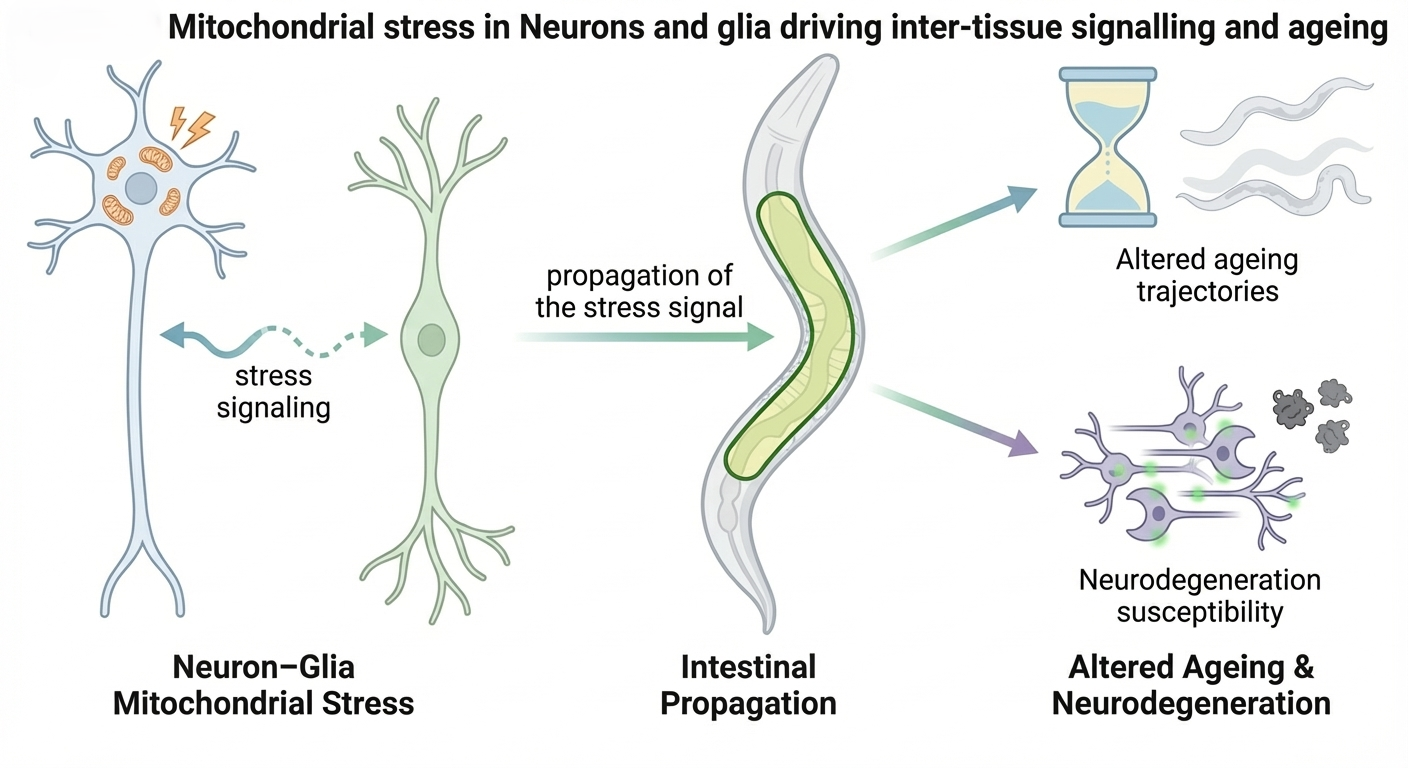

Our group investigates how mitochondrial stress is communicated between neurons and glial cells, and how this communication influences ageing, proteostasis and neurodegeneration. Our goal is to understand how the nervous system senses and transmits signals associated with mitochondrial dysfunction, and how these signals coordinate adaptive responses at the cellular, tissue and organismal levels.

We use Caenorhabditis elegans as a model system to study the mechanisms linking neuronal mitochondrial dysfunction with glial and systemic responses. This model allows us to combine genetics, cell biology, in vivo imaging and functional assays to examine how different cell types exchange information during stress. Through these approaches, we aim to define how neurons and glia cooperate to regulate mitochondrial homeostasis, integrated stress responses and longevity.

A central interest of the lab is to determine the role of glia as a regulatory hub for mitochondrial stress communication. While neurons have traditionally been viewed as key coordinators of systemic responses, we propose that glial cells act as essential interpreters and modulators of stress signals originating in the nervous system. Understanding this neuron-glia communication may reveal new principles explaining how organisms maintain homeostasis during ageing.

Our work also explores how mitochondrial stress responses can have beneficial or detrimental consequences depending on cellular, temporal and physiological context. In particular, we investigate how these signals affect proteostasis, neuronal function, inter-tissue communication and susceptibility to neurodegenerative processes. By identifying the molecular and cellular mechanisms connecting mitochondrial stress, glia and ageing, we seek to uncover conserved strategies that promote resilience against age-associated decline.

Overall, the lab aims to define how neuron-glia mitochondrial stress communication shapes organismal physiology and the ageing process, with a particular focus on its impact on neurodegeneration.

Group members


Current

  • Raúl Salas Escobar – Master Student

Former

  •  Paula Soto Carmona – Research technitian
 

Funding


  • PID2025-169578NA-I00. Mitochondrial stress in Neurons and glia driving inter-tissue signalling and ageing (MiNervA). Ministerio de Ciencia, Innovación y Universidades. Proyectos de Generación de Conocimiento – 2026. Pending final resolution. Principal Investigator.
  • Ayudas Puente para la concurrencia a Programas Internacionales de I+D+I Universidad Pablo de Olavide. 01/07/2024-01/07/2025. Investigador Principal.
  • Ayudas para el desarrollo de líneas de investigación propias Universidad Pablo de Olavide. 01/02/2025- 01/02/2026. Principal Investigator.
  • PRE2023-PID2022-139772NB-I00, Mitochondrial stress signalling: the role of histone deubiquitination in ageing regulation (MITDUBAGE). Ministerio de Ciencia e Innovación. Proyectos de Generación de Conocimiento – 2022. Investigadora Principal: Marta Artal Sanz. 01/09/2023- 31/08/2026. Member of the research team.
  • RYC2021‐031269‐I, Mitochondrial prohibitins in Nervous system degeneration and Ageing. Ministerio de Ciencia e Innovación. Ayudas para contratos Ramón y Cajal 2021. 01/04/2023 – 31/03/2028. Principal Investigator.


Recent publications


  • Sergio Gordillo-García*; (1/13) Jesus Fernandez-Abascal*; Blanca Hernando-Rodríguez; […] Marta Artal-Sanz. 2026. USP-48 enables insulin-mediated longevity and modulates the mitochondrial stress response. Cell Reports. Cell Press. Under second review. https://papers.ssrn.com/sol3/papers.cfm?abstract_id=6480948 *Equal contribution.
  • David R. Logan; Carlos D. Oliva; (6/10) Jesus Fernández-Abascal; Laura Bianchi. 2026. Glial-released serotonin drives nose touch responses in Caenorhabditis elegans. Cell Reports. Cell Press. 45(6):117553. https://doi.org/10.1016/j.celrep.2026.117553.
  • Graziano B, Wang L, White OR, Kaplan DH, Fernandez-Abascal J, Bianchi L. Glial KCNQ K+ channels control neuronal output by regulating GABA release from glia in C. elegans. Neuron. 2024 Mar 8; 112:1-16. DOI: https://doi.org/10.1016/j.neuron.2024.02.013.
  • Wang L, Graziano B, Encalada N, Fernandez-Abascal J, Kaplan DH, Bianchi L. Glial regulators of ions and solutes required for specific chemosensory functions in Caenorhabditis elegans. iScience. 2022 Dec 1;25(12):105684. DOI: https://doi.org/10.1016/j.isci.2022.105684.
  • Fernandez-Abascal J*, Artal-Sanz M*. Prohibitins in neurodegeneration and mitochondrial homeostasis. Front Aging. 2022 Nov 3;3:1043300. *Corresponding author. DOI: https://doi.org/10.3389/fragi.2022.1043300.
  • Fernandez-Abascal J, Wang L, Graziano B, Johnson CK, Bianchi L. Exon-dependent transcriptional adaptation by exon-junction complex proteins Y14/RNP-4 and MAGOH/MAG-1 in Caenorhabditis elegans. PLoS Genet. 2022 Oct 31;18(10):e1010488. DOI: https://doi.org/10.1371/journal.pgen.1010488.
  • Fernandez-Abascal J* and Bianchi L*. A protocol for imaging calcium and chloride in C. elegans glia upon touch stimulation. STAR Protocols. 2022 Jun 17;3(2):101282. *Corresponding author. DOI: https://doi.org/10.1016/j.xpro.2022.101282.
  • Fernandez-Abascal J, Johnson CK, Graziano B, Wang L, Encalada N, Bianchi L. A glial ClC Cl– channel mediates nose touch responses in C. elegans. Neuron. 2022 Feb 2;110(3):470-485.e7. DOI: https://doi.org/10.1016/j.neuron.2021.11.010.
  • Fernandez-Abascal J, Graziano B, Encalada N, Bianchi L. Glial chloride channels in the function of the nervous system across species. Ion channels in Biophysics and Physiology. Springer Nature. ISBN: 978-981-16-4253-1. 2021 Nov. DOI: https://doi.org/10.1007/978-981-16-4254-8.
  • Fernandez-Abascal J*, Chiaino E, Frosini M, Davey GP, Valoti M. β-naphthoflavone and ethanol reverse mitochondrial dysfunction in a parkinsonian model of neurodegeneration. International Journal of Molecular Sciences. Multidisciplinary Digital Publishing Institute (MDPI). 2020 May 31;21(11):3955. *Corresponding author DOI: https://doi.org/10.3390/ijms21113955.
  • Johnson CK*, Fernandez-Abascal J**, Wang Y, Wang L, Bianchi L. The Na+-K+-ATPase is needed in glia of touch receptors for responses to touch in C. elegans. J Neurophysiol. 2020 May 1;123(5):2064-2074. **Equal contribution. DOI: https://doi.org/10.1152/jn.00636.2019.
  • Fernandez-Abascal J*, Ripullone M, Valeri A, Leone C, Valoti M. β-Naphtoflavone and Ethanol Induce Cytochrome P450 and Protect Towards MPP⁺ Toxicity in Human Neuroblastoma SH-SY5Y Cells. International Journal of Molecular Sciences. Multidisciplinary Digital Publishing Institute (MDPI). 2018 Oct 28;19(11):3369. *Corresponding author. DOI: https://doi.org/10.3390/ijms19113369.