



The research co-led by Fernando Casares describes the first natural metamaterial, demonstrating that biology employs engineering and design principles once thought to be unique to humans. The study describes how insects use a triangular lattice composed of cells during their development to program the precise 3D shape of the adult eye. The discovery opens the door to “synthetic morphogenesis”: the ability to design living tissues with customized shapes for regenerative medicine.
A key area of research in the field of materials science focuses on the development of structures known as metamaterials: systems whose properties depend not solely on the substance from which they are made, but on how they are organized internally. A metamaterial is precisely engineered to behave in a specific way. In this field, a particularly interesting development is that of programmable metamaterials: systems designed to take on a specific 3D shape “when needed.”
Until now, creating something so complex was considered an achievement exclusive to human-developed technology. However, a new study published in the journal Nature Communications reveals that these principles have existed in nature for millions of years. An international scientific collaboration, led by laboratories at the University of Seville and the Seville Institute of Biomedicine (IBiS, Virgen del Rocío University Hospital/CSIC/University of Seville), the Laboratory for Molecular Cell Biology at University College London (UCL), and the Andalusian Center for Developmental Biology (CABD, CSIC/Pablo de Olavide University/Regional Government of Andalusia), has discovered the first programmable natural metamaterial in a living organism: the eye of the fruit fly Drosophila melanogaster.
The First Natural Metamaterial
Drosophila, the fruit fly, is one of the most powerful biological models in science. We share a large portion of our genes with it, as well as the way cells use these genes to form tissues and organs, which allows scientists to study complex processes such as morphogenesis: the process by which chemical and mechanical signals guide groups of cells to organize themselves and form an organ with a specific function and shape.
By definition, metamaterials were supposed to be artificial… until now. This multidisciplinary team has shown that, during its development, the fly’s eye possesses a network of interconnected cells forming triangles. What is striking is that the size of these cellular triangles is not uniform: in some areas, the triangles are larger than in others. This mesh functions exactly like a programmable metamaterial: the two-dimensional (2D) distribution of these triangles (the eye tissue during development) contains the precise instructions so that, when hydrostatic pressure is applied to the tissue (a process similar to inflating a water balloon), it assumes the exact three-dimensional (3D) curvature necessary for the adult fly to see properly.
“It’s fascinating to see how nature not only uses biology to shape organs, but also employs advanced engineering principles,” explain the lead authors. “Once again, biology surprises us by using mechanisms that have been in place for millions of years—mechanisms that, to us, represent cutting-edge technology,” says Juan Garrido García, the study’s first author.
“We have discovered that the fly’s eye has a 2D architectural ‘plan’ that predetermines its final 3D shape. This blueprint allows the fly’s eye to have flatter areas with higher visual acuity (for example, to identify fruits where its favorite food, yeast, grows, or to find a mate), and other more curved areas with lower resolution but a more panoramic view, for detecting predators. Another surprising aspect is its size: a fly’s eye has a diameter of approximately 0.5 millimeters. “The metamaterial nature of the developing eye allows for precise control of the eye’s shape at this tiny scale,” the researcher continues.
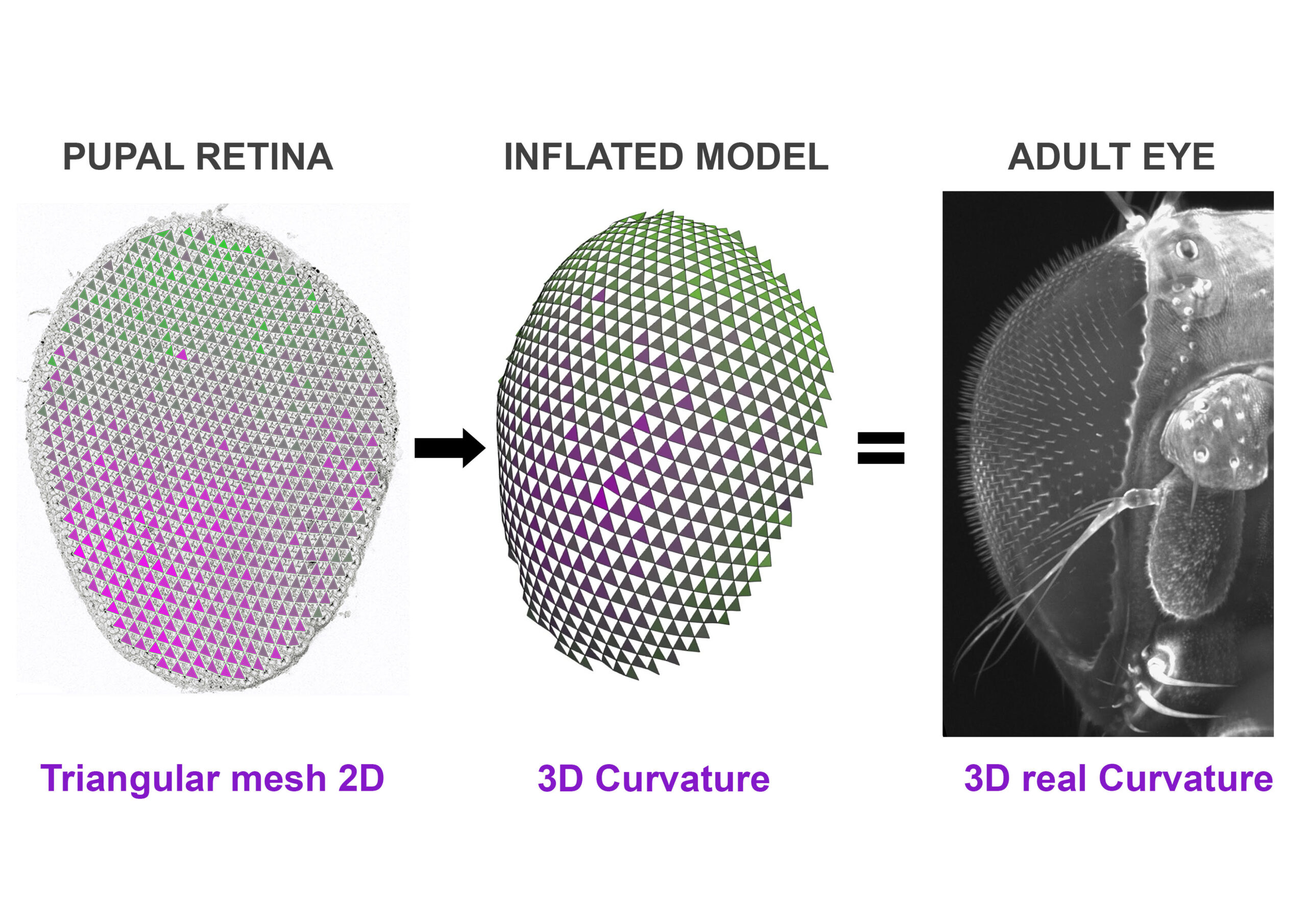
In the pupal stage, the cells that make up the Drosophila retina form a triangular lattice. In the image, triangles of different sizes are colored with varying shades of violet. The triangular lattice of the retina in the pupal stage functions as a metamaterial. Using a computational model, the team has demonstrated that inflating this (2D) lattice with the triangular pattern found in the pupal-stage tissue results in a 3D curvature similar to that of the adult eye.
Toward the Medicine of the Future: Synthetic Morphogenesis
Beyond its biological significance (it is possible that many other insects use this same metamaterial property to generate eyes of different shapes that serve different functions), this discovery lays the foundation for synthetic morphogenesis. By understanding how nature programs the shape of a tissue without the need for rigid external molds, scientists can begin to design “programmable living tissues.”
In the future, this ability to control the 3D shape of cell cultures using substrates with geometric patterns could revolutionize bioengineering, enabling the creation of artificial organs or grafts that, when implanted, take on their designed shape with unprecedented precision, eliminating the reliance on non-biological synthetic materials.
A global and multidisciplinary effort
This milestone was made possible by the synergy among various institutions, research centers, and scientific disciplines, bringing together the group led by Luis M. Escudero at the University of Seville and the IBiS—whose researchers include Juan Garrido García, an expert in the mathematical analysis of the organization of biological tissues— with the group led by CSIC researcher Fernando Casares at the CABD, leaders in the study of the development and evolution of the eye; and with Franck Pichaud’s team at the Laboratory for Molecular Cell Biology (UCL), specialists in the cell biology of epithelia and the visual system. By integrating cutting-edge cell biology and genetics with complex mathematical models and computational simulations—developed in collaboration with the Higher Technical School of Engineering at the University of Seville— the project demonstrates that the intersection of biology, mathematics, and engineering is essential to unraveling the secrets of life.
Reference:
A natural programmable metamaterial controls 3D curvature of compound eyes. Nature Communications. https://www.doi.org/10.1038/s41467-026-74276-6