



Multicellular Dynamics

Desarrollo del sistema hemato-vascular y células madre
Dra María José Sánchez Sanz

Investigador/a Principal

Resumen
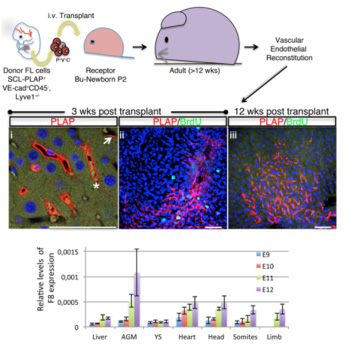


El empleo de células madre y células progenitoras en aplicaciones terapéuticas está limitado por la falta de información precisa sobre su comportamiento en procesos como mantenimiento de la homeostasis y en trasplantes. Los progenitores y células madre fetales presentan características distintivas comparados con  células equivalentes del adulto, incluyendo su potente capacidad de repoblación en trasplantes.  La investigación en células con características fetales es, por tanto, un tema de alto interés en el campo de estudio sobre las células madre. Nuestro trabajo está centrado en el análisis de los progenitores hematopoyéticos y vasculares derivados del hígado fetal y usamos el ratón como modelo experimental.
Líneas de investigación
1- Progenitores hemato/vasculares fetales versus adultos.
2- Notch y HSCs durante el desarrollo.
3- Desarrollo de modelos de terapia celular empleando progenitores hemato/vasculares fetales: La  hemofilia A.

1- Progenitores hemato/vasculares fetales versus adultos. Hemos identificado un nuevo progenitor hemato/vascular fetal caracterizado por su alta capacidad de injerto comparado con células equivalentes obtenidas de adulto. También hemos determinado el momento y localización de su aparición durante el desarrollo embrionario así como, establecido un sistema de cultivo de órgano para su expansión ex vivo. Estos estudios proporcionan un marco de trabajo para abordar la investigación sobre las señales y mecanismos moleculares involucrados en procesos de generación, proliferación e injerto.

2- Notch y HSCs durante el desarrollo.
 Estudiamos la diferente capacidad de injerto de HSCs fetales y adultas en respuesta a la activación de la ruta de señalización de Notch empleando células aisladas de transgénicos SCL-NIC. Los resultados de estos estudios podrían ser de interés en el diseño de tratamientos dirigidos a los diferentes tipos de HSC en enfermedades de la sangre.

3-Desarrollo de modelos de terapia celular empleando progenitores hemato/vasculares fetales: La  hemofilia A.  Buscamos aplicaciones de los progenitores hemato/vasculares fetales en el desarrollo de modelos de terapia celular, en particular para el tratamiento en estadios de recién nacidos. Una de las líneas de investigación está enfocada en la hemofilia A, una enfermedad causada por la deficiente producción de factor de coagulación FVIII en células endoteliales vasculares y hematopoyéticas. Hemos determinado que el FVIII se expresa en estadios tempranos del desarrollo y en progenitores hemato/vasculares del hígado fetal. Actualmente estamos investigando si el trasplante de estos progenitores en mutantes F8 rescata el fenotipo.

Empleando diferentes técnicas como el uso de líneas transgénicas para marcaje de progenitores y seguimiento en trasplantes, FACS, análisis de imagen, cultivos y diversos modelos de trasplantes, intentamos descifrar las propiedades de los progenitor fetales a nivel celular y molecular con el objetivo a largo plazo, de entender su función en mantenimiento de la homeostasis y mejorar su uso en aplicaciones terapéuticas.

Publicaciones relevantes


  • Merlin S, Akula S, Cottonaro A, Garcia-Leal T, Serrano LJ, Borroni E, Kalandadze V, Galiano R, Borsotti C, Liras A, Sanchez MJ*, Follenzi A*. (2023). Therapeutic potential of fetal liver cell transplantation in hemophilia a mice. Haematologica, 108: 1544-1554. *principal investigators, corresponding authors.
  • De Pablo-Moreno J, Serrano JL, Revuelta L, Sánchez MJ*, Liras A*. (2022). The vascular endothelium and coagulation: Homeostasis, Disease and treatment, with a focus on the Von Wilibrand factor, factors FVIII and  FV. Int. J. Mol. Sci. 23:8283-8294. *principal investigators, corresponding authors.
  • Hombría Castelli-Gair J, Sánchez MJ (2021). Translation of the book on CRISPR technology by the Nobel laureated J Doubna and S Sternberg: «A crack in creation: gene editing and the unthinkable power to control evolution». «Una grieta en la creación. CRISPR, la edición génica y el increíble poder de controlar la evolución. ISBM 978-84-918-887-8, Alianza Editorial.
  • Serrano Ramos LJ, Cañete A, Garcia-Leal T, Tomas-Gallardo L, Flores AI, De la Torre P, Liras A and Sanchez MJ. (2018). Searching for a cellbased therapeutic tool for haemophilia A within the embryonic foetal liver and the aortagonads- mesonephros (AGM) region. Throm&Haem, 118: 1370-1381.
  • Cañete-Sánchez, Ana; Carmona-Megias, Rita; Ariza, Laura;Sanchez-Sanz, Maria Jose; Rojas, Anabel;  Muñoz-Chapuli-Oriol, Ramon. (2017). A population of hematopoietic stem cells derives from GATA4-expressing progenitors located in the placenta and lateral mesoderm of mice. Haematologica. 102: 647-655.
  • Cañete A, Comaills V, Prados I, Castro AM, Hammad S, Ybot-Gonzalez P, Bockamp E, Hengstler JG, Gottgens B, Sanchez MJ. (2017). Characterization of a Fetal Liver Cell Population Endowed with Long-Term Multiorgan Endothelial Reconstitution Potential. Stem Cells. 35: 507-521.
  • Wilkinson AC, Goode DK, Cheng YH, Dickel DE, Foster S, Sendall T, Tijssen MR, Sanchez MJ, Pennacchio LA, Kirkpatrick AM, Gottgens B. (2013). Single site-specific integration targeting coupled with embryonic stem cell differentiation provides a high-throughput alternative to in vivo enhancer analyses. Biol Open 2: 1229-38.
  • Gottgens B, Ferreira R, Sanchez MJ, Ishibashi S, Li J, Spensberger D, Lefevre P, Ottersbach K, Chapman M, Kinston S, Knezevic K, Hoogenkamp M, Follows GA, Bonifer C, Amaya E, Green AR. (2010). cis-Regulatory remodeling of the SCL locus during vertebrate evolution. Mol Cell Biol 30: 5741-51.
  • Garcia-Ortega AM, Cañete A, Quinter C, Silberstein L, Piquer-Gil M, Alvarez-Dolado M, Dekel B, Gottgens B, Sanchez M.J. (2010).  Enhanced hematovascular contribution of SCL 3′ enhancer expressing fetal liver cells uncovers their potential to integrate in extramedullary adult niches. Stem Cells 28: 100-12.

Miembros del laboratorio y Colaboradores


Miembros del laboratorio

Investigadora principal:

Dr María José Sánchez, +34 954 348943

Miembros del laboratorio:

Gabriel Martinez Lasso de la Vega
Alejandra Huecas Zarzuelo

Antiguos miembros:

Berke Dindar, ERASMUS student
Ruben Sánchez Rodríguez, Master student.
María E. López Naranjo, Master student.
​​​​​​​Carlos Rangel Pelaez, Master student.
Miguel Minguet Oses, Garantia Juvenil.
​​​​​​​Celia Juarez Calvillo
Tamara García Leal
Rocio Galiano Saavedra
Ana Cañete
Isabel Prados
Valentine Comaills
María Gómez de Salazar
Ana María Castro
J. Antonio Guerrero Martínez
Dilara Perver
Esther Roldán Amaro
Cristina Quintero Ruiz
Miguel Garcia Ortega

Colaboradores

Dr Patricia Ybot Gonzalez, IBIS (Seville, Spain)
Dr Mario Cordero Morales, Universidad Pablo de Olavide (Seville, Spain)
Dr Antonio Liras, Universidad Complutense de Madrid (Spain)
Dr Antonia Follenzi, Universitá del Piamonte Orientali, (Novara, Italy)
Dr Simone Masalini,Universitá del Piamonte Orientali, (Novara, Italy)

Plan Andaluz de Investigación, Desarrollo e Innovación (PAIDI)

We form part of the group BIO295 – Mechanisms of Animal Development

Lista completa de publicaciones


Orcid: 0000-0003-3464-6224

  • Merlin S, Akula S, Cottonaro A, Garcia-Leal T, Serrano LJ, Borroni E, Kalandadze V, Galiano R, Borsotti C, Liras A, Sanchez MJ*, Follenzi A*. (2023). Therapeutic potential of fetal liver cell transplantation in hemophilia a mice. Haematologica, 108: 1544-1554. *principal investigators, corresponding authors.
  • De Pablo-Moreno J, Serrano JL, Revuelta L, Sánchez MJ*, Liras A*. (2022). The vascular endothelium and coagulation: Homeostasis, Disease and treatment, with a focus on the Von Wilibrand factor, factors FVIII and  FV. Int. J. Mol. Sci. 23:8283-8294. *principal investigators, corresponding authors.
  • Hombría Castelli-Gair J, Sánchez MJ (2021). Translation of the book on CRISPR technology by the Nobel laureated J Doubna and S Sternberg: «A crack in creation: gene editing and the unthinkable power to control evolution». «Una grieta en la creación. CRISPR, la edición génica y el increíble poder de controlar la evolución. ISBM 978-84-918-887-8, Alianza Editorial.
  • Serrano Ramos LJ, Cañete A, Garcia-Leal T, Tomas-Gallardo L, Flores AI, De la Torre P, Liras A and Sanchez MJ. (2018). Searching for a cellbased therapeutic tool for haemophilia A within the embryonic foetal liver and the aortagonads- mesonephros (AGM) region. Throm&Haem, 118: 1370-1381
  • Cañete-Sánchez, Ana; Carmona-Megias, Rita; Ariza, Laura;Sanchez-Sanz, Maria Jose; Rojas, Anabel;  Muñoz-Chapuli-Oriol, Ramon. (2017). A population of hematopoietic stem cells derives from GATA4-expressing progenitors located in the placenta and lateral mesoderm of mice. Haematologica. 102: 647-655.
  • Canete A, Comaills V, Prados I, Castro AM, Hammad S, Ybot-Gonzalez P, Bockamp E, Hengstler JG, Gottgens B, Sanchez MJ. (2017). Characterization of a Fetal Liver Cell Population Endowed with Long-Term Multiorgan Endothelial Reconstitution Potential. Stem Cells. 35: 507-521
  • Wilkinson AC, Goode DK, Cheng YH, Dickel DE, Foster S, Sendall T, Tijssen MR, Sanchez MJ, Pennacchio LA, Kirkpatrick AM, Gottgens B. (2013). Single site-specific integration targeting coupled with embryonic stem cell differentiation provides a high-throughput alternative to in vivo enhancer analyses. Biol Open 2: 1229-38
  • Gottgens B, Ferreira R, Sanchez MJ, Ishibashi S, Li J, Spensberger D, Lefevre P, Ottersbach K, Chapman M, Kinston S, Knezevic K, Hoogenkamp M, Follows GA, Bonifer C, Amaya E, Green AR. (2010). cis-Regulatory remodeling of the SCL locus during vertebrate evolution. Mol Cell Biol 30: 5741-51
  • Garcia-Ortega AM, Canete A, Quinter C, Silberstein L, Piquer-Gil M, Alvarez-Dolado M, Dekel B, Gottgens B, Sanchez M.J. (2010).  Enhanced hematovascular contribution of SCL 3′ enhancer expressing fetal liver cells uncovers their potential to integrate in extramedullary adult niches. Stem Cells 28: 100-12
  • Piquer-Gil M, Garcia-Verdugo JM, Zipancic I, Sanchez MJ, Alvarez-Dolado M. (2009). Cell fusion contributes to pericyte formation after stroke. J Cereb Blood Flow Metab 29: 480-5.
  • Bockamp E, Antunes C, Liebner S, Schmitt S, Cabezas-Wallscheid N, Heck R, Ohnngemach S, Oesch-Bartlomowicz B, Rickert C, Sanchez MJ, Hengstler J, Kaina B, Wilson A, Trumpp A, Eshkind L. (2009). In vivo fate mapping with SCL regulatory elements identifies progenitors for primitive and definitive hematopoiesis in mice. Mech Dev 126: 863-72
  • Smith AM, Sanchez MJ, Follows GA, Kinston S, Donaldson IJ, Green AR, Gottgens B. 2008. A novel mode of enhancer evolution: the Tal1 stem cell enhancer recruited a MIR element to specifically boost its activity. Genome Res 18: 1422-32.
  • Dekel B, Metsuyanim S, Garcia AM, Quintero C, Sanchez MJ*, Izraeli S. (2008). Organ-injury-induced reactivation of hemangioblastic precursor cells. Leukemia 22: 103-13 (*last senior author).
  • Silberstein L, Sanchez MJ, Socolovsky M, Liu Y, Hoffman G, Kinston S, Piltz S, Bowen M, Gambardella L, Green AR, Gottgens B. (2005). Transgenic analysis of the stem cell leukemia +19 stem cell enhancer in adult and embryonic hematopoietic and endothelial cells. Stem Cells 23: 1378-88.
  • Gottgens B, Broccardo C, Sanchez MJ, Deveaux S, Murphy G, Gothert JR, Kotsopoulou E, Kinston S, Delaney L, Piltz S, Barton LM, Knezevic K, Erber WN, Begley CG, Frampton J, Green AR. (2004). The scl +18/19 stem cell enhancer is not required for hematopoiesis: identification of a 5′ bifunctional hematopoietic-endothelial enhancer bound by Fli-1 and Elf-1. Mol Cell Biol 24: 1870-83.
  • Dekel B, Hochman E, Sanchez MJ, Maharshak N, Amariglio N, Green AR, Izraeli S. (2004). Kidney, blood, and endothelium: developmental expression of stem cell leukemia during nephrogenesis. Kidney Int 65: 1162-9.
  • Murphy GJ, Gottgens B, Vegiopoulos A, Sanchez MJ, Leavitt AD, Watson SP, Green AR, Frampton J. (2003). Manipulation of mouse hematopoietic progenitors by specific retroviral infection. J Biol Chem 278: 43556-63.
  • Sinclair AM, Bench AJ, Bloor A, Li J, Gottgens B, Stanley M, Miller J, Piltz S, Hunter S, Nacheva EP, Sanchez MJ, Green AR. (2002). Rescue of the lethal scl(-/-) phenotype by the human SCL locus. Blood 99: 3931-8.
  • Gottgens B, Nastos A, Kinston S, Piltz S, Delabesse EC, Stanley M, Sanchez MJ, Ciau-Uitz A, Patient R, Green AR.( 2002). Establishing the transcriptional programme for blood: the SCL stem cell enhancer is regulated by a multiprotein complex containing Ets and GATA factors. EMBO J 21: 3039-50.
  • de Bruijn MF, Ma X, Robin C, Ottersbach K, Sanchez MJ, Dzierzak E. (2002). Hematopoietic stem cells localize to the endothelial cell layer in the midgestation mouse aorta. Immunity 16: 673-83.
  • Chen CZ, Li M, de Graaf D, Monti S, Gottgens B, Sanchez MJ, Lander ES, Golub TR, Green AR, Lodish HF. 2002. Identification of endoglin as a functional marker that defines long-term repopulating hematopoietic stem cells. Proc Natl Acad Sci USA 99: 15468-73.
  • Bloor AJ, Sanchez MJ, Green AR, Gottgens B. 2002. The role of the stem cell leukemia (SCL) gene in hematopoietic and endothelial lineage specification. J Hematother Stem Cell Res 11: 195-206.
  • Sanchez MJ, Bockamp E, Miller J, Gambardella L, Green A. 2001. Selective rescue of early haematopoietic progenitors in Scl(-/-) mice by expressing Scl under the control of a stem cell enhancer. Development 128: 4815.
  • Gottgens B, Barton LM, Gilbert JG, Bench AJ, Sanchez MJ, Bahn S, Mistry S, Grafham D, McMurray A, Vaudin M, Amaya E, Bentley DR, Green AR, Sinclair AM. 2000. Analysis of vertebrate SCL loci identifies conserved enhancers. Nat Biotechnol 18: 181-6.
  • Sinclair AM, Gottgens B, Barton LM, Stanley ML, Pardanaud L, Klaine M, Gering M, Bahn S, Sanchez MJ, Bench AJ, Fordham JL, Bockamp E, Green AR. 1999. Distinct 5′ SCL enhancers direct transcription to developing brain, spinal cord, and endothelium: neural expression is mediated by GATA factor binding sites. Dev Biol 209: 128-42.
  • Sanchez MJ, Gottgens B, Sinclair AM, Stanley M, Begley CG, Hunter S, Green AR. 1999. An SCL 3′ enhancer targets developing endothelium together with embryonic and adult haematopoietic progenitors. Development 126: 3891-904
  • Bockamp EO, Fordham JL, Gottgens B, Murrell AM, Sanchez MJ, Green AR. 1998. Transcriptional regulation of the stem cell leukemia gene by PU.1 and Elf-1. J Biol Chem 273: 29032-42.
  • Miles C, Sanchez MJ, Sinclair A, Dzierzak E. 1997. Expression of the Ly-6E.1 (Sca-1) transgene in adult hematopoietic stem cells and the developing mouse embryo. Development 124: 537-47.
  • Dzierzak E, Sanchez MJ, Muller A, Miles C, Holmes A, Tidcombe H, Medvinsky A. 1997. Hematopoietic stem cells: embryonic beginnings. J Cell Physiol 173: 216-8.
  • Sanchez MJ, Holmes A, Miles C, Dzierzak E. 1996. Characterization of the first definitive hematopoietic stem cells in the AGM and liver of the mouse embryo. Immunity 5: 513-25.
  • Spits H, Barcena A, Hori T, Sanchez MJ, Phillips JH, Galy A. 1994. Early events in human intrathymic T-cell development. Res Immunol 145: 128-34; discussion 55-8.
  • Sanchez MJ, Muench MO, Roncarolo MG, Lanier LL, Phillips JH. 1994. Identification of a common T/natural killer cell progenitor in human fetal thymus. J Exp Med 180: 569-76.
  • Sanchez MJ, Spits H, Lanier LL, Phillips JH. 1993. Human natural killer cell committed thymocytes and their relation to the T cell lineage. J Exp Med 178: 1857-66.
  • Sanchez MJ, Gutierrez-Ramos JC, Fernandez E, Leonardo E, Lozano J, Martinez C, Toribio ML. 1993. Putative prethymic T cell precursors within the early human embryonic liver: a molecular and functional analysis. J Exp Med 177: 19-33.
  • Cabrero E, Sanchez MJ, Gutierrez C. 1992. The requirements for growth of in vivo activated autoimmune B cells are similar to those of in vitro generated lipopolysaccharide B cell blasts and dissimilar to anti-IgM plus IL-4 induced B lymphoblasts. J Autoimmun 5: 289-303.
  • Gutierrez C, Aparicio MJ, Sanchez MJ, Cabrero E. 1991. Lack of correlation between in vitro immunological alterations and the development of scleroderma-like skin lesions in toxic oil syndrome patients. Dermatologica 183: 123-8.
  • Barcena A, Sanchez MJ, de la Pompa JL, Toribio ML, Kroemer G, Martinez AC. 1991. Involvement of the interleukin 4 pathway in the generation of functional gamma delta T cells from human pro-T cells. Proc Natl Acad Sci USA 88: 7689-93.
  • Martinez C, Gutierrez-Ramos JC, de la Pompa JL, Leonardo E, Sanchez MJ, Alonso JM, Toribio ML. 1990. The thousand and one ways of being a T cell. Thymus 16: 173-85.