



Evolutionary Dynamics
Evolutionary Analysis of Low Complexity Regions

Dr. Pablo Mier Muñoz
Researcher
SUMMARY
Visit the page of the LCE group for more information.
Low Complexity Regions (LCRs) are proteins regions where the frequency distribution of amino acids deviates from the common amino acid usage. Residues in LCRs have been estimated to represent 20% and 8% of all known sequences of eukaryotes and prokaryotes, respectively. In the definition of LCRs, multiple concepts related to sequence composition, periodicity and structure have been used. Regarding amino acid composition, while there is a general notion that LCRs in proteins should have an excess of one or a few types of amino acid residues, there is no consensus about which metrics are the most appropriate. Additionally, the concept of LCR is intermingled with the concept of sequence repeats. Repeats are inevitably associated with LCRs, since shorter repeats result in regions with lower amino acid diversity.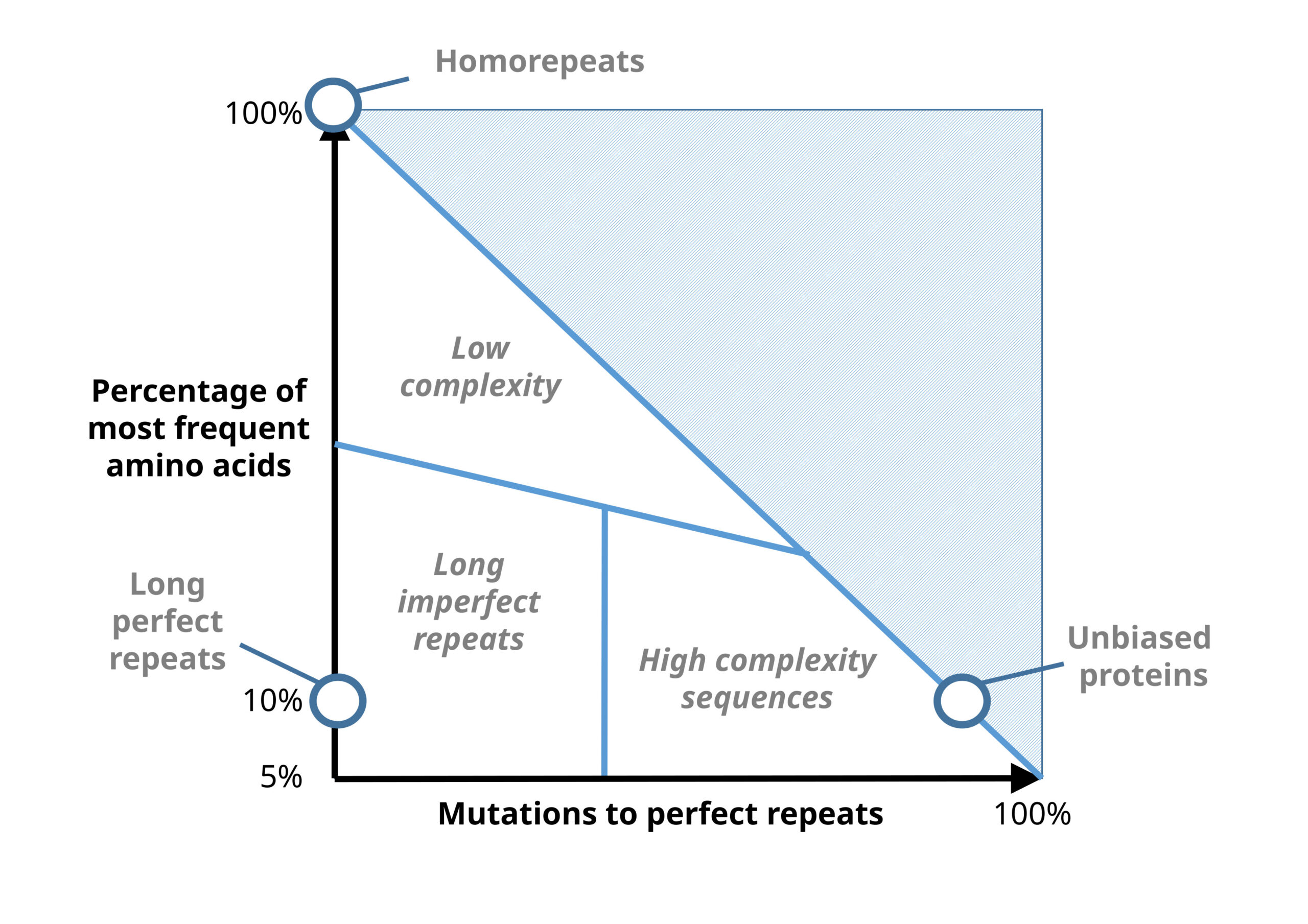
Homorepeats, polyX or amino acid repeats, are protein motifs defined as consecutive runs of a single residue. They are the simplest LCRs and rely on a highly localized abundance of an amino acid. Any amino acid can form them, although some polyX are much more abundant than others (which also depends on the species taxonomy). They are associated with multiple functionalities, from aiding protein localization to mediating protein–protein interactions. Many homorepeats have not been functionally characterized yet, despite their high abundance in eukaryotes. This makes them an interesting protein motif for a post-sequencing step in terms of proteome annotation.
Five relevant publications
Lab members & collaborators
Lab members
Beatriz Galindo
Researcher:
Dr. Pablo Mier
PhD student:
Nerea Blanco
Collaborators
Dr. Miguel Andrade-Navarro (Johannes Gutenberg University Mainz, Germany)
Dr. Pau Bernadó (Centre de Biochimie Structurale, France)
Dr. Aleksandra Gruca (Silesian University of Technology, Poland)
Dr. Marcin Grynberg (Institute of Biochemistry and Biophysics, Poland)
Dr. David Kreil (University of Natural Resources and Life Sciences Vienna, Austria)
Dr. Enrique Morett (Universidad Nacional Autonoma de Mexico, Mexico)