



Multicellular Dynamics
Developmental control
Summary
In our group, we are interested in understanding how cells make decision collectively such that not only they take on specific fates, but they do so in precise numbers and patterns.
As a mode organism, we use Drosophila, and as the (main) experimental subject the development of its eye. Our research uses a variety of approaches, including developmental genetics, genomics, genome editing, quantitative imaging, and mathematical and computational modeling.
At present, we are pursuing the following questions:
- Feedback control. Development -the process by which organisms build themselves- is strikingly robust. This is because it is endowed with feedback mechanisms. However, these feedbacks work by integrating processes at very different scales: molecular, cell, tissue and organismal levels. We are investigating one specific feedback control process that ensures that left and right eyes reach a very similar size (1). In this feedback, the Dpp/BMP signaling pathway plays a major role regulating proportion of progenitor cells that undergo apotosis. Understanding this feedback thus requires understanding why progenitors are prone to die and how Dpp signaling rescues them.
- Transition states and the regulation of developmental “flows”. Every time a group of cells makes a choice during development, it needs to enter a peculiar state, called a transition state. In this state, cells become more heterogeneous (as measured by single-cell transcriptomics), a heterogeneity that has been interpreted as necessary to allow cells to access multiple potential developmental paths before becoming biased toward one of them. Most research has focused on characterizing the intermediate, stepping-stone states that cells go through along their developmental trajectory. However, we are focusing on understanding how cells enter into and exit the transition state. This state is not only critical to allow the progression of developmental trajectories, but also to control the proportion of cells that follow alternative pathways -that is, the flow along the developmental trajectories.
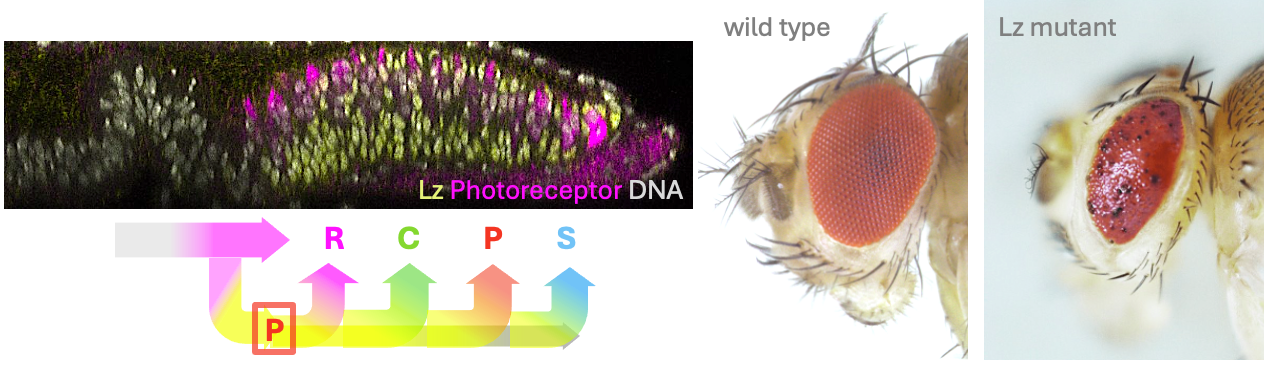
- Natural Reprogramming. We are focusing on one particularly striking developmental choice and its associated transition state. During the development of the Drosophila eye, proneural cells choose between two alternatives: either differentiating directly into photoreceptors (R cells, neurons specialized in light detection) or becoming “reprogrammed” into a new progenitor state in which cells “forget” their proneural program. As a consequence, these cells are able to differentiate not only into a new tier of R cells, but also into several other non-neural cell types. If you know the Waddington landscape metaphor, it is as if some cells were moving uphill the landscape.
If you are further interested in our work, you can follow this link to a full list of publications or stay on this website and check a description of our current Specific Projects.
You can also visit out NEWS page where we post about our lab’s life.
And if you’d like to join our group, please, contact Fernando Casares: fcasfer@upo.es
Lab members & Collaborators
Current Lab Members
Tel.: +34 954 348 965
Fernando Casares (PI)
fcasfer@upo.es | +34 954 348 947
Genoveva Guerrero
PhD Student
gguejim@upo.es
Reinaldo Sáez
PhD Studento
rsaemor@upo.es
Paulina Londoño
PhD Student
plontam@alu.upo.es
Miguel Brun-Usan
Postdoctoral Researcher (MOMENTUM Program)
m.brunusan@gmail.com
Antonella Iannini
Lab Manager
aiannini@upo.es
Antonio J. Díaz
Lab Technician
ajdiaper1@upo.es
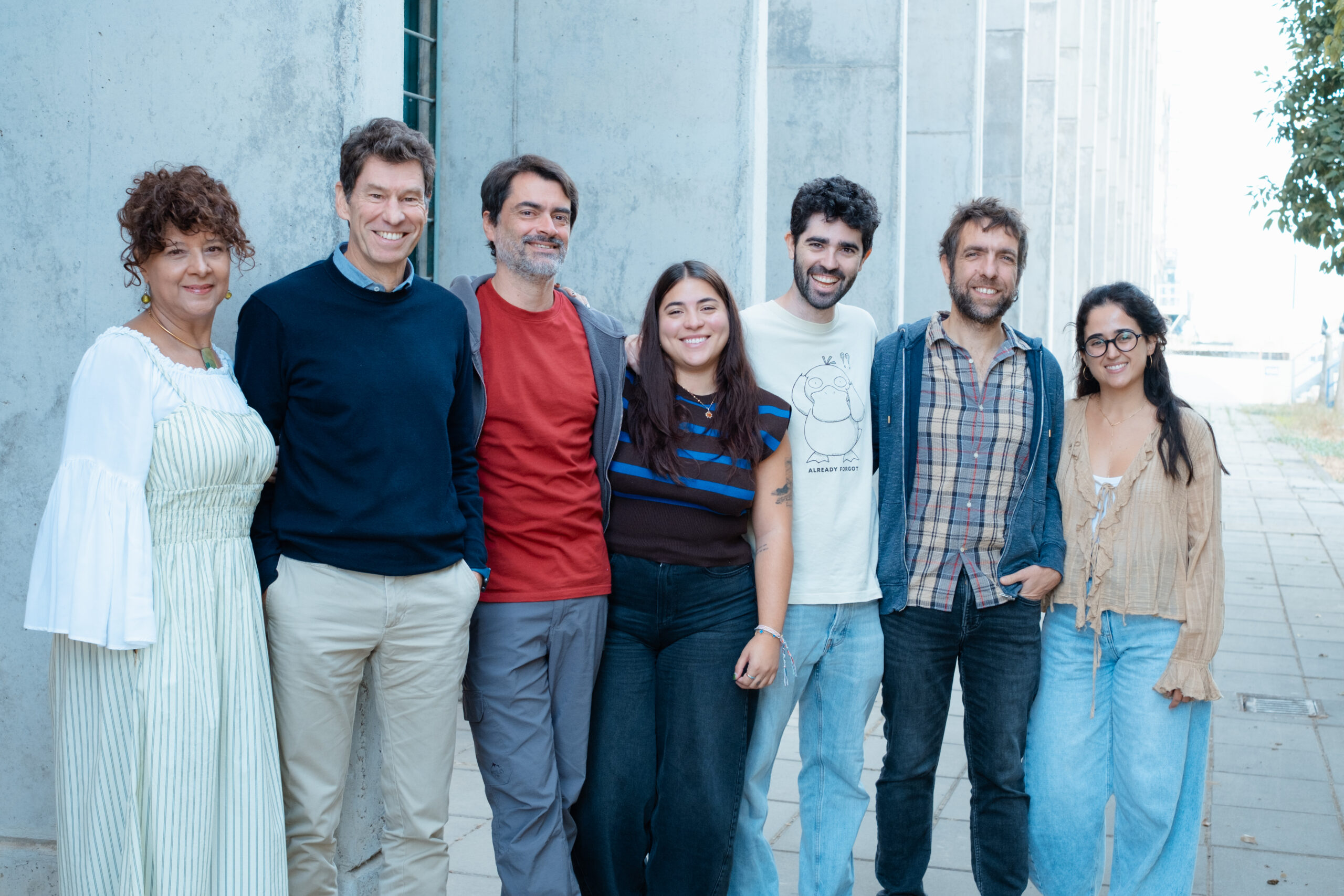
From left to right: Antonella Iannini, Fernando Casares, Antonio Díaz, Paulina Londoño, Reinaldo Sáez, Miguel Brun-Usan, Genoveva Guerrero.
Collaborators
Proyecto ALIS
- Luciano Marcón (CABD)
- Elena Camacho (CABD/US)
- Juan Poyatos (MNCN)
- Miguel Brun-Usan (CABD)
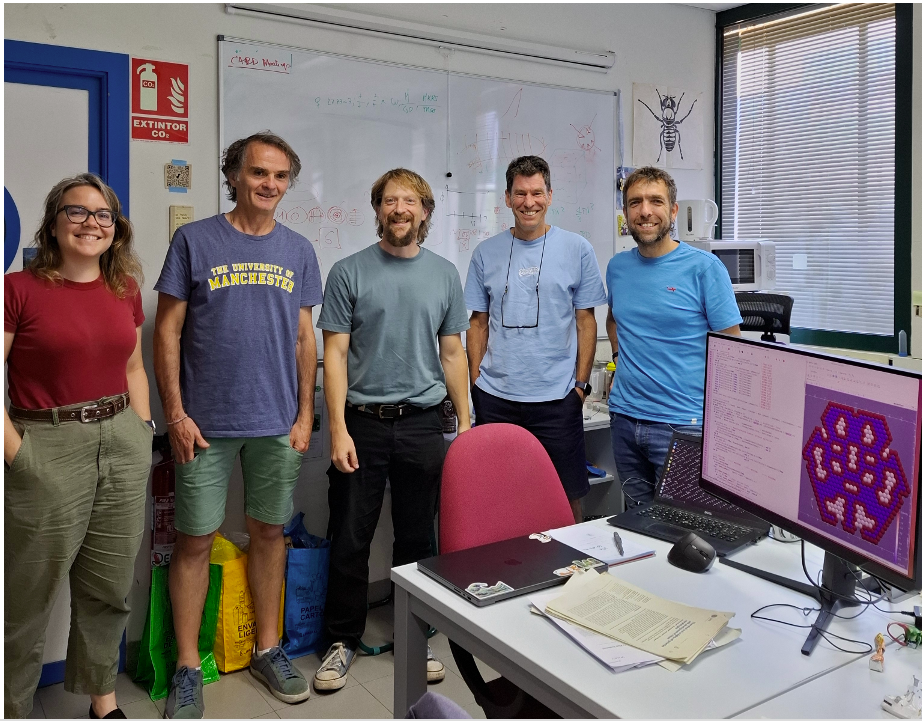
From left to right: Elena Camacho-Aguilar, Juan Poyatos, Luciano Marcon, Fernando Casares, Miguel Brun-Usan.
-
- Franck Pichaud, University College London (UCL), Londres, Reino Unido.
- Dagmar Iber, ETH Zürich, Basilea, Suiza.
- Alejandro Cuetos, Universidad Pablo de Olavide (UPO), Sevilla, España.
- David G. Míguez, CBM-SO/UAM, Madrid, España.
- Saúl Ares, CNB/CSIC-UAM, Madrid, España.
- Alistair McGregor, Durham University, Durham, Reino Unido.