


Organismal Dynamics

Metabolism, antioxidant systems and aging
Dr Guillermo López Lluch

 Researcher

Summary


Oxidative stress is linked to age-related accumulation of cellular damage and death. To date, caloric restriction (CR) is the most robust, non-genetic intervention able to increase lifespan and to reduce the rate of aging in several animal species. However, the mechanism involved in the anti-aging effect of CR are to date not completely understood, but it seems clear that a reduction of oxidative damage together with more efficient bioenergetic processes, specially linked to mitochondria, are mainly implicated.

Our main research line study the effect of CR and its mimetics such as resveratrol on the metabolic changes involved in a more efficient use of organic fuel by mitochondria and the antioxidant mechanisms involved in the prevention of oxidative damage of cellular components.

The group has carried out several projects granted by the Junta de Andalucía (Consejería de Turismo, Comercio y Deporte) and also by the Spanish Ministery of Education and Science (DEP2005-00238-C04-04/EQUI, “Caloric restriction and sport performance) in which we will study the effect of CR and mild exercise in the bioenergetic of muscle and the oxidative damage produced by extreme exercise in muscle, liver, brain and plasma in mice. The main goal of the research program was to establish the mechanisms involved in the anti-aging effect of CR and mild exercise at several levels: muscle, liver, brain, etc. We also studied different parameters involved in mitochondrial activity in muscle and also several oxidative damage markers in different tissues and plasma after extreme exercise.
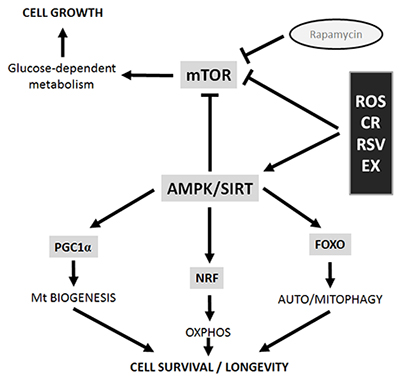
As it can be seen in figure 2, caloric restriction (CR), exercise (EX) and resveratrol (RSV) can induce AMPK and Sirtuin activities in different cells triggering mechanisms involved in mitochondrial homeostasis, oxidative respiration activation, mitochondrial biogenesis and auto/mitophagy. All these mechanisms are involved in the mitochondrial role in aging and linked to antioxidant activation during aging.

We have also carried out a second project on the same subject granted by the Spanish Ministery of Science and Innovatio (DEP2009-12019). We determine if resveratrol, a polyphenol considered as a CR mimetic, can affect physiological parameters related to exercise and affect physical activity. The results obtained in this project are very promising and will be published soon.

Taken into consideration the results obtained in the las two project involving CR or resveratrol and the response to physical activity, we proposed to determine the epigenetic mechanisms involved in the different age-dependent response found in these project. In fact, the 1st february 2013, we will start with a new project that will determine these mechanisms in CR, resveratrol and/or exercised animals granted by the Spanisn Ministery of Economy and Competitivity (DEP-2012-39985).

In all these studies and another one funded by the Andalusian Government (Andalusian Centre for Sport Medicine: IMD2012SC0002) we have also studying the regulation of the mechanism of synthesis of coenzyme Q, the lipophilic electron transport member of mitochondria and the main antioxidant compound in plasma membranes in CR and the role of coenzyme Q in plasma membrane to compensate the redox equilibrium in the whole cell. This component can be importantly implicated in aging process.
 

Relevant publications 


1: Sumbalová Z, Kucharská J, Rausová Z, Palacka P, Kovalčíková E, Takácsová T, Mojto V, Navas P, Lopéz-Lluch G, Gvozdjáková A. Reduced platelet mitochondrial respiration and oxidative phosphorylation in patients with post COVID-19 syndrome are regenerated after spa rehabilitation and targeted ubiquinol therapy. Front Mol Biosci. 2022 Oct 21;9:1016352.

2: Gvozdjáková A, Sumbalová Z, Kucharská J, Rausová Z, Kovalčíková E, Takácsová T, Navas P, López-Lluch G, Mojto V, Palacka P. Mountain spa rehabilitation improved health of patients with post-COVID-19 syndrome: pilot study. Environ Sci Pollut Res Int. 2022 Sep 23:1–12.

3: Hernández-Camacho JD, Fernández-Ayala DJM, Vicente-García C, Navas-Enamorado I, López-Lluch G, Oliva C, Artuch R, Garcia-Villoria J, Ribes A, de Cabo R, Carvajal JJ, Navas P. Calorie Restriction Rescues Mitochondrial Dysfunction in Adck2-Deficient Skeletal Muscle. Front Physiol. 2022 Jul 14;13:898792.

4: Fernández-Portero C, Amián JG, de la Bella R, López-Lluch G, Alarcón D. Coenzyme Q10 levels associated to cognitive functioning and executive function in older adults. J Gerontol A Biol Sci Med Sci. 2022 Jul 31:glac152.

5: de la Bella-Garzón R, Fernández-Portero C, Alarcón D, Amián JG, López-Lluch G. Levels of Plasma Coenzyme Q10 Are Associated with Physical Capacity and Cardiovascular Risk in the Elderly. Antioxidants (Basel). 2022 Jan 29;11(2):279.

6: Hernández-Camacho JD, García-Corzo L, Fernández-Ayala DJM, Navas P, López-Lluch G. Coenzyme Q at the Hinge of Health and Metabolic Diseases. Antioxidants (Basel). 2021 Nov 8;10(11):1785.

7: Beà A, Valero JG, Irazoki A, Lana C, López-Lluch G, Portero-Otín M, Pérez-Galán P, Inserte J, Ruiz-Meana M, Zorzano A, Llovera M, Sanchis D. Cardiac fibroblasts display endurance to ischemia, high ROS control and elevated respiration regulated by the JAK2/STAT pathway. FEBS J. 2022 May;289(9):2540-2561.

8: Santos-Ocaña C, Cascajo MV, Alcázar-Fabra M, Staiano C, López-Lluch G, Brea-Calvo G, Navas P. Cellular Models for Primary CoQ Deficiency Pathogenesis Study. Int J Mol Sci. 2021 Sep 22;22(19):10211.

9: Navas P, Cascajo MV, Alcázar-Fabra M, Hernández-Camacho JD, Sánchez-Cuesta A, Rodríguez ABC, Ballesteros-Simarro M, Arroyo-Luque A, Rodríguez-Aguilera JC, Fernández-Ayala DJM, Brea-Calvo G, López-Lluch G, Santos-Ocaña C. Secondary CoQ10 deficiency, bioenergetics unbalance in disease and aging. Biofactors. 2021 Jul;47(4):551-569.

10: López-Lluch G. Coenzyme Q homeostasis in aging: Response to non-genetic interventions. Free Radic Biol Med. 2021 Feb 20;164:285-302.

11: Carneros D, López-Lluch G, Bustos M. Physiopathology of Lifestyle Interventions in Non-Alcoholic Fatty Liver Disease (NAFLD). Nutrients. 2020 Nov 12;12(11):3472.

12: Moreno Fernández-Ayala DJ, Navas P, López-Lluch G. Age-related mitochondrial dysfunction as a key factor in COVID-19 disease. Exp Gerontol. 2020 Dec;142:111147.

13: Blasco N, Beà A, Barés G, Girón C, Navaridas R, Irazoki A, López-Lluch G, Zorzano A, Dolcet X, Llovera M, Sanchis D. Involvement of the mitochondrial nuclease EndoG in the regulation of cell proliferation through the control of reactive oxygen species. Redox Biol. 2020 Oct;37:101736.

14: Sánchez-Cuesta A, Cortés-Rodríguez AB, Navas-Enamorado I, Lekue JA, Viar T, Axpe M, Navas P, López-Lluch G. High coenzyme Q10 plasma levels improve stress and damage markers in professional soccer players during competition. Int J Vitam Nutr Res. 2022 Jul;92(3-4):192-203.

15: Meza-Torres C, Hernández-Camacho JD, Cortés-Rodríguez AB, Fang L, Bui Thanh T, Rodríguez-Bies E, Navas P, López-Lluch G. Resveratrol Regulates the Expression of Genes Involved in CoQ Synthesis in Liver in Mice Fed with High Fat Diet. Antioxidants (Basel). 2020 May 15;9(5):431.

16: López-Lluch G. The Important Role of CoQ10 in Aging. Antioxidants (Basel). 2019 Nov 20;8(12):570.

17: Vázquez-Fonseca L, Schaefer J, Navas-Enamorado I, Santos-Ocaña C, Hernández-Camacho JD, Guerra I, Cascajo MV, Sánchez-Cuesta A, Horvath Z, Siendones E, Jou C, Casado M, Gutiérrez P, Brea-Calvo G, López-Lluch G, Fernández-Ayala DJM, Cortés-Rodríguez AB, Rodríguez-Aguilera JC, Matté C, Ribes A, Prieto-Soler SY, Dominguez-Del-Toro E, Francesco AD, Aon MA, Bernier M, Salviati L, Artuch R, Cabo R, Jackson S, Navas P. <i>ADCK2</i> Haploinsufficiency Reduces Mitochondrial Lipid Oxidation and Causes Myopathy Associated with CoQ Deficiency. J Clin Med. 2019 Sep 2;8(9):1374.

18: Spinazzi M, Radaelli E, Horré K, Arranz AM, Gounko NV, Agostinis P, Maia TM, Impens F, Morais VA, Lopez-Lluch G, Serneels L, Navas P, De Strooper B. PARL deficiency in mouse causes Complex III defects, coenzyme Q depletion, and Leigh-like syndrome. Proc Natl Acad Sci U S A. 2019 Jan 2;116(1):277-286.

19: Sañudo B, Muñoz T, Davison GW, Lopez-Lluch G, Del Pozo-Cruz J. High-Intensity Interval Training Combined With Vibration and Dietary Restriction Improves Body Composition and Blood Lipids in Obese Adults: A Randomized Trial. Dose Response. 2018 Sep 5;16(3):1559325818797015.

20: López-Lluch G, Del Pozo-Cruz J, Sánchez-Cuesta A, Cortés-Rodríguez AB, Navas P. Bioavailability of coenzyme Q10 supplements depends on carrier lipids and solubilization. Nutrition. 2019 Jan;57:133-140.

21: López-Lluch G, Hernández-Camacho JD, Fernández-Ayala DJM, Navas P. Mitochondrial dysfunction in metabolism and ageing: shared mechanisms and outcomes? Biogerontology. 2018 Dec;19(6):461-480.

22: Gutiérrez-Casado E, Khraiwesh H, López-Domínguez JA, Montero-Guisado J, López-Lluch G, Navas P, de Cabo R, Ramsey JJ, González-Reyes JA, Villalba JM. The Impact of Aging, Calorie Restriction and Dietary Fat on Autophagy Markers and Mitochondrial Ultrastructure and Dynamics in Mouse Skeletal Muscle. J Gerontol A Biol Sci Med Sci. 2019 May 16;74(6):760-769.

23: Carrasco-Garcia E, Moreno-Cugnon L, Garcia I, Borras C, Revuelta M, Izeta A, Lopez-Lluch G, de Pancorbo MM, Vergara I, Vina J, Matheu A. SOX2 expression diminishes with ageing in several tissues in mice and humans. Mech Ageing Dev. 2019 Jan;177:30-36.

24: Hernández-Camacho JD, Bernier M, López-Lluch G, Navas P. Coenzyme Q10 Supplementation in Aging and Disease. Front Physiol. 2018 Feb 5;9:44.


Lab members & Collaborators


Lab members


Group leader

Dr. Guillermo López-Lluch, +34 95434 9384. e-mail: glopllu@upo.es

Researchers

Dra. Elizabeth Rodríguez Bies, Contratada Doctora +34 954349381 (Restricción calórica, ejercicio y rendimiento muscular).
Dña. Ana María Sánchez Cuesta, Técnico Superior de Investigación.

PhD Students

Rocío de la Bella Garzón (Ejercicio, capacidad cognitiva y coenzima Q10)
Francisco Reyes Laredo (Coenzima Q10 en el futbol femenino)
Catherine Meza Torres (Nutraceuticos y regulación antioxidante)

Collaborators 

Dr. José Manuel Villalba Montoro (Universidad de Córdoba)
Dra. Cristina Fernández Portero (Universidad Pablo de Olavide)
Dr. Josué García Amián (Universidad Pablo de Olavide)
Dr. David Alarcón Rubio (Universidad Pablo de Olavide).
Dr. Jesús del Pozo (Universidad de Sevilla)
Dra. Anna Gvozdjáková (universidad de Bratislava)