Evolutionary Dynamics

Gene Regulation and Evolution


Dra Francisca Martinez Real

Principal Investigator

Summary


Our research goal is to understand how genomic changes translate into developmental phenotypes during evolution. Specifically, we study how the non-coding genome has evolved to modulate gene expression in different tissues and organisms.

We apply cutting-edge technologies to investigate gene regulation at different levels, including 3D chromosome conformation capture, single-cell technologies and epigenetic approaches. By integrating genomic data in inter-species comparative analyses, we aim to unravel shared and divergent mechanisms controlling developmental processes. We validate our findings in vivo, using transgenic mice, linking changes in genome sequence and regulation with the emergence of specific traits.

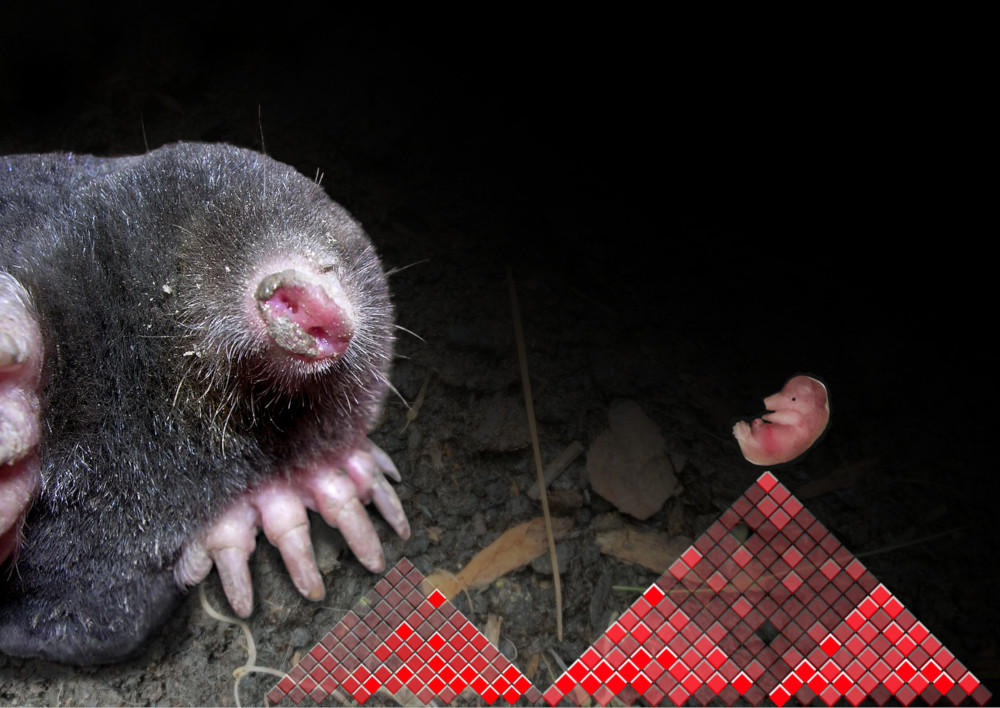
Our research is focused on the biology of the mole, a species with a compendium of unique traits that makes it a fascinating model to study gene regulatory evolution. Moles live underground and have consequently evolved distinct phenotypes adapted to subterranean environments. These include eye degeneration, resistant to hypoxia or extremely adapted limbs that allow them to “swim” in soil or water. Furthermore, female moles are intersexual as they develop ovotestes instead of ovaries, like most mammals. Ovotestes produce high amounts of testosterone, similar to males, which masculinize female moles and render them stronger to survive in fossorial environments. In previous research, we have generated a chromosome-resolved genome for the Iberian mole, Talpa occidentalis, thus enabling genomic and gene regulation studies in this iconic species. Using this valuable resource, we demonstrated that the development of ovotestes is associated to changes in the 3D regulatory domains of sex-specific genes (Real et al, Science 2020). Therefore, using the mole as a model, our group combines comparative genomics, 3D gene regulation and transgenic approaches to model evolution in vivo.

For more details, visit our website and explore our research! fmreallab.github.io/website/

Five relevant publications


  1. Magdalena Schindler, Christian Feregrino, Silvia Aldrovandi, Bai-Wei Lo, Anna A. Monaco, Alessa R. Ringel, Ariadna Morales, Tobias Zehnder, Rose Yinghan Behncke, Juliane Glaser, Alexander Barclay, Guillaume Andrey, Bjørt K. Kragesteen, René Hägerling, Stefan Haas, Martin Vingron, eIgor Ulitsky, Marc Marti-Renom, Julio Hechavarria, Nicolas Fasel, Michael Hiller, Darío Lupiáñez, Stefan Mundlos, Francisca M. Real. 2024. Comparative single-cell analyses reveal evolutionary repurposing of a conserved gene program in bat wing development. 2025. Nat Ecol Evol. Jul 16. doi: 10.1038/s41559-025-02780-x.

    Comparative single-cell analyses reveal evolutionary repurposing of a conserved gene program in bat wing development

  2. Alicia Hurtado*, Irene Mota-Gómez*, Miguel Lao*, Francisca M. Real, Johanna Jedamzick, Miguel Burgos, Darío G. Lupiáñez, Rafael Jiménez, Francisco J. Barrionuevo. 2024. Complete male-to-female sex reversal in XY mice lacking the miR-17∼92 cluster. Nat. Commun. 15(1):3809.
  3. Magdalena Schindler, Marco Osterwalder, Izabela Harabula; Larw Wittler, Athanasia C Tzika, Dina K N Dechmann, Martin Vingron, Axel Visel, Stefan A Haas, Francisca M. Real. 2023. Induction of kidney-related gene programs through co-option of SALL1 in mole ovotestes. Development.  150 (17): e150_e1702.
  4. Chiara Anania*, Rafael D. Acemel*, Johanna Jedamzick, Adriano Bolondi, Giulia Cova, Norbert Brieske, Ralf Kühn, Lars Wittler, Francisca M. Real, Darío G. Lupiáñez. 2022. In vivo dissection of a clustered-CTCF domain boundary reveals developmental principles of regulatory insulation. Nature Genetics. 54 (1026–1036).
  5. Francisca M. Real*, Miguel Lao-Pérez*, Miguel Burgos, Stefan Mundlos, Darío G. Lupiáñez, Rafael Jiménez, and Francisco J. Barrionuevo. 2022. Cell adhesion and immune response, two main functions altered in the transcriptome of seasonally regressed testes of two mammalian species. J Exp Zool B Mol Dev Evol. DOI: 10.1002/jez.b.23142.
  6. Francisca M. Real, Stefan A. Haas, Paolo Franchini, Peiwen Xiong, Oleg Simakov, Heiner Kuhl, Robert Schöpflin, David Heller, M-Hossein Moeinzadeh, Verena Heinrich, Thomas Krannich, Annkatrin Bressin, Michaela F Hartmann, Stefan A Wudy, Dina K N Dechmann, Alicia Hurtado, Francisco J Barrionuevo, Magdalena Schindler, Izabela Harabula, Marco Osterwalder, Michael Hiller, Lars Wittler, Axel Visel, Bernd Timmermann, Axel Meyer, Martin Vingron, Rafael Jiménez, Stefan Mundlos, Darío G. Lupiáñez. 2020. The mole genome reveals regulatory rearrangements associated with adaptive intersexuality. Science. Vol 370, Issue 6513, pp. 208-214.

Lab members & Collaborators


Lab Members

Principal Investigator:

Francisca Martínez Real. fmarrea@upo.es

PhD student: 

Rubén Sánchez Rodríguez

PhD student: 

José Ignacio Quesada Márquez


Collaborators

Prof. Gary Lewin. Max Delbrück Center for Molecular Medicine (Berlin, Germany).
Prof. Jef Boeke. Center for Synthetic Regulatory Genomics at NYU Langone Health (New York, USA).
Prof. Marc Marti-Renom. Centre Nacional d’Anàlisi Genòmica (CNAG), Centre for Genomic Regulation (CRG) (Barcelona, Spain).
Prof. Michael Hiller. Loewe Center for Translational biodiversity genomics (Frankfurt, Germany).
Dr. Jane Reznick. CECAD Excellent in Aging Research at the University of Cologne (Germany).