



Genome Dynamics

Cis-regulatory landscape dynamics in development and disease
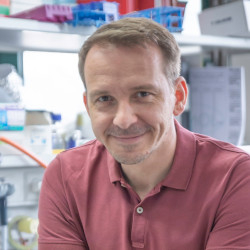
Dr Martin Franke

Researcher

Summary 


Our research focuses on mechanisms of how genes are switched on and off at a particular tissue and at a precise time point. This spatio-temporal control of gene expression is crucial during embryonic development and a prerequisite for the generation of different cell types that built the animal body plan. Key regulators in this process are cis-regulatory elements, such as enhancers that act as switches in the genome to regulate gene expression and that constitute the regulatory landscapes of developmental genes. This regulatory information is organized by the three-dimensional (3D) chromatin structure in animal genomes that ensures the correct enhancer regulates its target gene.

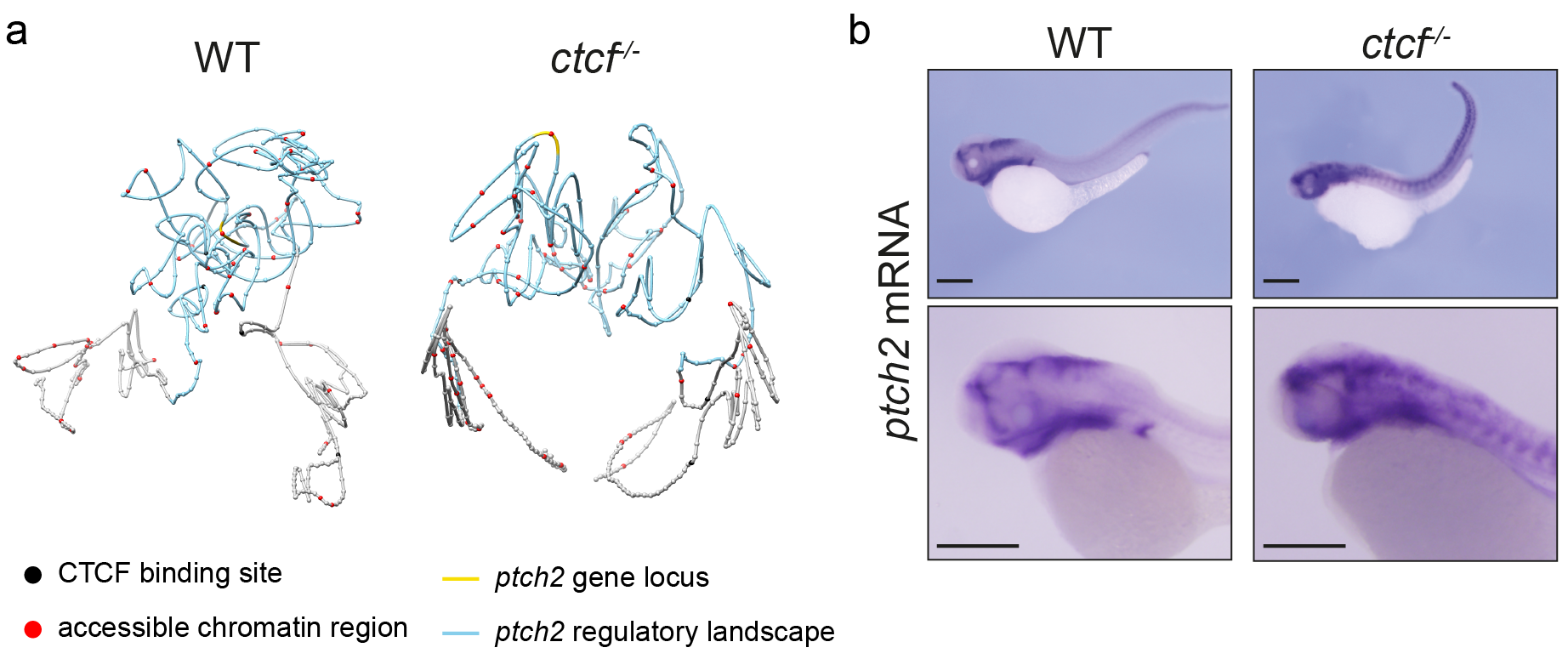
We aim at understanding the functional relationship between enhancers, gene expression, and 3D chromatin structure in an in vivo context, in particular zebrafish. Specifically, we apply CRISPR-Cas genome editing to dissect the role of 3D chromatin structure mediated by key architectural proteins, such as the DNA-binding factor CTCF, at a tissue-resolution level and within a whole organism (Figure 1). To do so, we combine epigenomic and transcriptomic approaches with single-cell experiments and chromosome-conformation-capture technologies to elucidate how 3D chromatin structure “feeds” distinct cell stimuli into developmental and cell differentiation programs.  

Figure 1. a) Representative models of the 3D chromatin structure of the ptch2 regulatory landscape in wild-type (WT) and ctcf knockout zebrafish embryos at 48 hours post-fertilisation (hpf). b) Whole-mount in situ hybridization of ptch2 in wild-type and ctcf knockout zebrafish embryos at 48 hpf. (Franke et al., 2021, Nat. Commun.)

How enhancers and the 3D chromatin structure of our genome translate into function is crucial to understand human genetic diseases. Changes that affect the regulatory landscape of a gene can lead to gene misexpression, resulting in developmental defects or cancer (Franke et al., 2016, Nature; Franke et al., 2022, AJHG). Together with our collaboration partners, it is our aim to improve the diagnosis of patients with regulatory mutations. To do so, we apply chromosome conformation capture technologies in patient cells in order to trace changes in chromatin interactions and to identify candidate disease-causing genes and enhancers.


Five relevant publications 


  • Franke M, Daly AF, Palmeira L, Tirosh A, Stigliano A, Trifan E, Faucz FR, Abboud D, Petrossians P, Tena JJ, et al.: Duplications disrupt chromatin architecture and rewire GPR101-enhancer communication in X-linked acrogigantism. The American Journal of Human Genetics (02/2022), 109:553–570.
  • Franke M, de la Calle-Mustienes, E., Neto, A., Almuedo-Castillo, M., Irastorza-Azcarate, I., Acemel, R. D., Tena, J. J., Santos-Pereira, J. M., & Gómez-Skarmeta, J. L. (2021). CTCF knockout in zebrafish induces alterations in regulatory landscapes and developmental gene expression. Nature Communications (09/2021) 12:1, 12(1), 1–19. https://doi.org/10.1038/s41467-021-25604-5
  • Alexandra Despang, Robert Schöpflin, Martin Franke, Salaheddine Ali, Ivana Jerković, Christina Paliou, Wing-Lee Chan, Bernd Timmermann, Lars Wittler, Martin Vingron, Stefan Mundlos, Daniel M. Ibrahim: Functional dissection of the Sox9–Kcnj2 locus identifies nonessential and instructive roles of TAD architecture. Nature Genetics (08/2019); 51(8)., DOI:10.1038/s41588-019-0466-z
  • Martin Franke, José Luis Gómez-Skarmeta: An evolutionary perspective of regulatory landscape dynamics in development and disease. Current Opinion in Cell Biology (07/2018); 55., DOI:10.1016/j.ceb.2018.06.009
  • Franke M, Ibrahim DM, Andrey G, Schwarzer W, Heinrich V, Schöpflin R, Kraft K, Kempfer R, Jerković I, Chan WL, Spielmann M, Bernd Timmermann, Wittler L, Kurth I, Cambiaso P, Zuffardi O, Houge G, Lambie L, Brancati F, Pombo A, Vingron M, Spitz F, Stefan Mundlos: Formation of new chromatin domains determines pathogenicity of genomic duplications. Nature (10/2016); 538 (7624). DOI: 10.1038/nature19800

Lab members & collaborators

Associated Investigator

Dr. Martin Franke


Lab Manager

Dr. Sara María Ortega Campos (shared position with Dr. Christina Paliou)


Research Assistant

Almudena Neva Alejo


PhD Student

Paula Soto Carmona


Alumni

Dr. Marta Moreno Oñate (PhD Student, co-supervised by Dr. Juan J. Tena)
Leon Schmitz (Erasmus+ Intern)
Manuel Durán Acosta (Master Student, co-supervised by Dr. José María Santos Pereira)

Collaborators

Elisa de la Calle-Mustienes (CABD, Seville, Spain)
Dr. Juan Ramón Martínez-Morales (CABD, Seville, Spain)
Dr. Dario Lupiáñez (CABD, Seville, Spain)
Dr. Juan J. Tena (CABD, Seville, Spain)
Dr. Adrian F. Daly (University of Liège, Liège, Belgium)
Dr. Giampaolo Trivellin (Humanitas Research Hospital, Milan, Italy)
Dr. Irene Delgado and Dr. Miguel Torres (CNIC, Madrid, Spain)
Dr. Cristina González Aguilera (Cabimer, Seville, Spain)