



Organismal Dynamics
Control of nuclear proteostasis
Dra Silvia Salas Pino
Researcher
Summary
Nuclear pores (NPCs) are macromolecular complexes embedded in the nuclear envelope that allow nucleocytoplasmic trafficking of proteins and RNAs. In recent years however, new roles of NPCs have been uncovered, including the anchoring of chromatin regulatory factors, the cyclical recruitment of cell cycle regulators, the association of specific loci whose regulation occurs locally at the NPC, etc. The nuclear envelope is not homogeneous but harbours different chromatin domains. NPCs contribute to generate these chromatin microenvironments in the nuclear periphery where the regulation of gene silencing or activation occurs and whose deregulation impairs genome expression and integrity.
TPR (“Translocated Promoter Region”) nucleoporins are multifunctional proteins that are evolutionarily conserved from yeast to humans. TPR nucleoporins localize in the nucleoplasmic part of the NPC, forming the structure called “nuclear basket” where they participate in the regulation of nuclear processes such as the recruitment to the nuclear periphery of components of the mitotic checkpoint during interphase, the regulation of SUMOylation, export and quality control of mRNAs, etc. Our laboratory has recently uncovered a new role of the nuclear basket in the regulation of the proteasome at the nuclear periphery. The proteasome is responsible for the degradation of short-lived as well as defective proteins. Among its substrates are cell cycle regulators such as cyclins and cohesins and therefore its function is directly linked to the regulation of cell proliferation. Due to this role in cell cycle control, the proteasome is an important antitumor target. On the other hand, the regulation of cellular proteostasis by the proteasome by eliminating misfolded or damaged proteins is critical for cell viability. Therefore, defects in the function of the proteasome are associated with several neurodegenerative disorders characterized by the abnormal accumulation of protein aggregates. 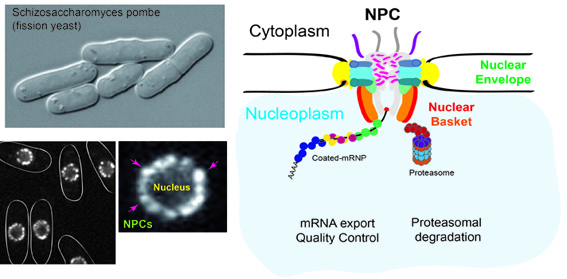
We use the fission yeast (Schizosaccharomyces pombe) as model organism and a combination of cell biology, live-cell microscopy, biochemistry and genomic techniques to uncover new roles of the NPC and specifically the nuclear basket in the regulation of nuclear proteostasis. We have previously shown that the localization and function of the proteasome is affected in nuclear basket mutants and this results in defects in the maintenance of the kinetochores and therefore in defects in chromosome segregation (Salas-Pino et al, 2017). We are currently studying a potential role of the nuclear basket in the assembly or final maturation of the nuclear proteasome. We are also conducting systematic screenings of drug collections looking for compounds that affect the location or function of the nuclear proteasome, with the aim to discover new chemical modulators that may have pharmacological applications.
Our laboratory is also interested in the regulation of NPCs and nuclear proteostasis under stress conditions. We have recently described that acute heat stress induces the reversible aggregation of multiple nuclear proteins, including nuclear basket proteins and other structural components of the NPC, mRNA maturation and export factors, as well as chromatin and cycle regulators in the nucleolus (Gallardo et al, 2020). In contrast to what occurs in neurodegenerative diseases such as Alzheimer’s or Parkinson’s diseases, where irreversible amyloid-like aggregation affects cell viability, this protein aggregation in response to stress is modulated and reversed by the action of chaperones and disaggregases once the stress condition has ceased. This supports the emergent view of regulated protein aggregation as a cellular protection mechanisms since it prevents the degradation of partially unfolded proteins and represents an excellent system to study and pharmacologically intervene protein aggregation.
Five relevant publications
Lab members & Collaborators
Lab members
Associated Investigator
Dr Silvia Salas Pino
PhD students
Gabriel Ruiz Romero
Ana Sánchez Molina
María Expósito Serrano
Mª Dolores Berdún Reina
Enrique Alanís Domínguez
Collaborators
Dr Fred Chang. University of California, San Francisco
Dr Mark Hochstrasser. Yale School of Medicine
Dra Elena Hidalgo. Univertitat Pompeu Fabra
Dr Antonio Pérez Pulido. CABD
Dra Ana Rojas Mendoza. CABD